Skip over navigation

Cambridge University Faculty of Mathematics NRich logo
menu search
  • Teachers expand_more
    • Early years
    • Primary
    • Secondary
    • Post-16
    • Events
    • Professional development
  • Students expand_more
    • Primary
    • Secondary
    • Post-16
  • Parents expand_more
    • Early Years
    • Primary
    • Secondary
    • Post-16
  • Problem-Solving Schools
  • About NRICH expand_more
    • About us
    • Impact stories
    • Support us
    • Our funders
    • Contact us
  • search

Or search by topic

Number and algebra

  • The Number System and Place Value
  • Calculations and Numerical Methods
  • Fractions, Decimals, Percentages, Ratio and Proportion
  • Properties of Numbers
  • Patterns, Sequences and Structure
  • Algebraic expressions, equations and formulae
  • Coordinates, Functions and Graphs

Geometry and measure

  • Angles, Polygons, and Geometrical Proof
  • 3D Geometry, Shape and Space
  • Measuring and calculating with units
  • Transformations and constructions
  • Pythagoras and Trigonometry
  • Vectors and Matrices

Probability and statistics

  • Handling, Processing and Representing Data
  • Probability

Working mathematically

  • Thinking mathematically
  • Developing positive attitudes
  • Cross-curricular contexts

Advanced mathematics

  • Decision Mathematics and Combinatorics
  • Advanced Probability and Statistics
  • Mechanics
  • Calculus

For younger learners

  • Early Years Foundation Stage

It's a Fence!

Age 5 to 11
Challenge Level Yellow star
  • Problem
  • Getting Started
  • Student Solutions
  • Teachers' Resources


We had some good responses from the John Cabot Academy in Bristol UK.

Hannah and Mary wrote:


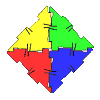
We think the triangle format would work better with the circular fence, you would be able to have more triangle arranged trees and you would have more land if you wanted to put up more fences. Also, you would pollute the earth less by having more trees in one fence.

Jess and Katie added:


We thought about it and we think that the shapes which will work better are a circle, an octagon or a decagon.

Connor, Ben, Ray, Natty, Aimee and Laura said that $14$ in triangles was best.

But Emily and Megan said that their solution was to build a fence around the trangular trees, so you can get at least $16$ trees in there. I guess that many more ideas came to people's minds but were not sent in. Remember we are very interested in whatever comes out of these explorations.


You may also like
Tangrams

Can you make five differently sized squares from the interactive tangram pieces?

Polydron

This activity investigates how you might make squares and pentominoes from Polydron.

Baked Bean Cans

Is there a best way to stack cans? What do different supermarkets do? How high can you safely stack the cans?

  • Tech help
  • Accessibility Statement
  • Sign up to our newsletter
  • Twitter X logo

The NRICH Project aims to enrich the mathematical experiences of all learners. To support this aim, members of the NRICH team work in a wide range of capacities, including providing professional development for teachers wishing to embed rich mathematical tasks into everyday classroom practice.

NRICH is part of the family of activities in the Millennium Mathematics Project.

University of Cambridge logo NRICH logo