Skip over navigation
Cambridge University Faculty of Mathematics NRich logo
menu search
  • Teachers expand_more
    • Early years
    • Primary
    • Secondary
    • Post-16
    • Events
    • Professional development
  • Students expand_more
    • Primary
    • Secondary
    • Post-16
  • Parents expand_more
    • Early Years
    • Primary
    • Secondary
    • Post-16
  • Problem-Solving Schools
  • About NRICH expand_more
    • About us
    • Impact stories
    • Support us
    • Our funders
    • Contact us
  • search

Or search by topic

Number and algebra

  • The Number System and Place Value
  • Calculations and Numerical Methods
  • Fractions, Decimals, Percentages, Ratio and Proportion
  • Properties of Numbers
  • Patterns, Sequences and Structure
  • Algebraic expressions, equations and formulae
  • Coordinates, Functions and Graphs

Geometry and measure

  • Angles, Polygons, and Geometrical Proof
  • 3D Geometry, Shape and Space
  • Measuring and calculating with units
  • Transformations and constructions
  • Pythagoras and Trigonometry
  • Vectors and Matrices

Probability and statistics

  • Handling, Processing and Representing Data
  • Probability

Working mathematically

  • Thinking mathematically
  • Developing positive attitudes
  • Cross-curricular contexts

Advanced mathematics

  • Decision Mathematics and Combinatorics
  • Advanced Probability and Statistics
  • Mechanics
  • Calculus

For younger learners

  • Early Years Foundation Stage

The Numbers Give the Design

Age 7 to 11
Challenge Level Yellow star
Primary curriculum
  • Problem
  • Getting Started
  • Student Solutions
  • Teachers' Resources

We had a collection of responses from Hymers College School. Katie wrote that while doing the challenge she found out a lot of different shapes the different tables made. She added that some people may say "How would you know when to end the sequence?". But the answer was that the shapes will end where you started. On a few of the tables she figured that once you have got the hang of the pattern you would be able to do the sequence backwards like on the $2$ times table. Ishita wrote:-
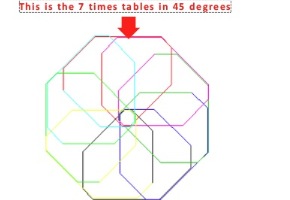
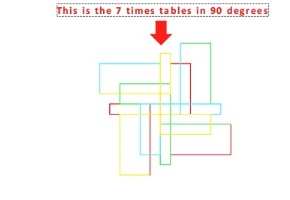
The things I have discovered are in the $7$ times table, in which I experimented on and I found out that in the $7$ times table, if on Microsoft Windows Logo, if you turn left $45$ degrees, it takes $8$ times before it meets with the point were it started and the angles are a lot larger, it is actually $2$ times as large as the $7$ times table in $90$ degrees.
 
When I do the $7$ times table, but then I turn left $90$ degrees it is a totally different shape and it only takes $4$ times to connect to the start from the end, and in comparison, it is a much smaller shape. This means that if I have a different angle on one of the times tables, for example the $3$s, it would be different in comparison of size, quantity in times of having it meet the start and in the style of the shape.  

 Ishita bIshita a

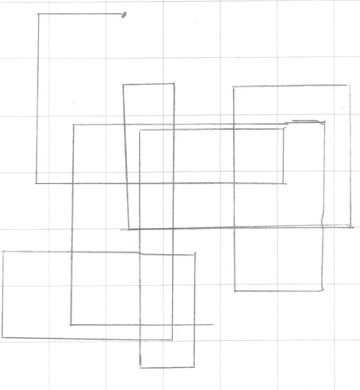
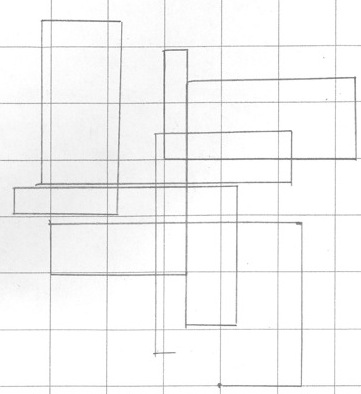
From the same school we also had responses from Jessica, Jamie and Quintin. Here are their pictures:-
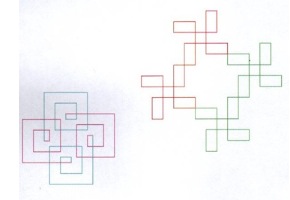
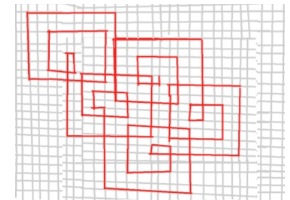
 Small J & JSmall Quintin

A teacher from Stanmore Primary School wrote:-

Key Stage 1 maths group have investigated what happens if they use the three times table to draw their pattern. They found that the pattern repeated and that it rotated. The tricky bit was keeping track of which way to turn and making sure that you drew a straight line!
 
Next week they are going to investigate what happens if they use a different times table to create their pattern. They made some predictions: 'it might be the same pattern but a different size' and 'it might be a different pattern but it will still repeat and still rotate'.
 
They thought that it was amazing that using numbers could create a repeating pattern. 
 

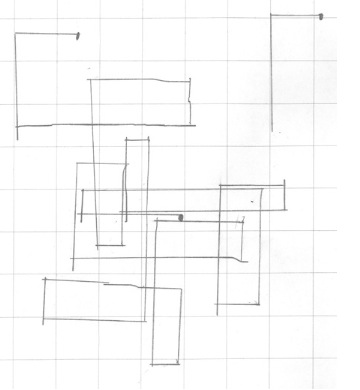
Here are some images they sent in:

 KS1 a

 
 KS1b
 

 KS1c

Nina from Wolfson Hillel School sent us the following notes. These impressed me; particularly her ideas which led to the picture.
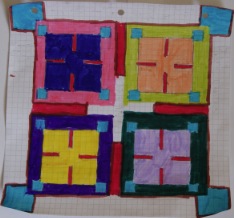
For my design I chose to use prime numbers. I made a pattern which went $3,2,7,5,1,5,7,2,3$; once I had gone round four times and had made a full shape I decided to make smaller version of it inside it. I knew that for my full shape I needed a square that measured $21$cms by $21$cms so I measured inside the shape and I found I could make four squares that measured $7$cms by $7$cms so I divided all the numbers by three as $21$ divided by $3$ equals $7$. Then I coloured all the bits in between $5,1,5$ red, all the corners blue and the rest I just chose nice colours, then I went over the regular sized shape's outline in brown. 
 nina
 

You may also like

Exploring Wild & Wonderful Number Patterns

EWWNP means Exploring Wild and Wonderful Number Patterns Created by Yourself! Investigate what happens if we create number patterns using some simple rules.
Magazines

Let's suppose that you are going to have a magazine which has 16 pages of A5 size. Can you find some different ways to make these pages? Investigate the pattern for each if you number the pages.
Pebbles

Place four pebbles on the sand in the form of a square. Keep adding as few pebbles as necessary to double the area. How many extra pebbles are added each time?

  • Tech help
  • Accessibility Statement
  • Sign up to our newsletter
  • Twitter X logo

The NRICH Project aims to enrich the mathematical experiences of all learners. To support this aim, members of the NRICH team work in a wide range of capacities, including providing professional development for teachers wishing to embed rich mathematical tasks into everyday classroom practice.

NRICH is part of the family of activities in the Millennium Mathematics Project.

University of Cambridge logo NRICH logo