Skip over navigation


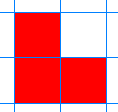
A triomino is a shape made from three squares. Here is an L-triomino:
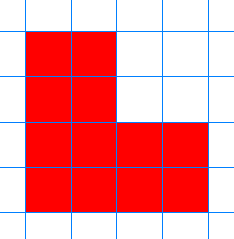
Here is a size 2 L-triomino:
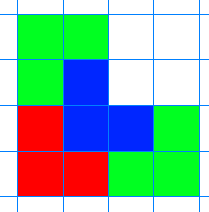
It can be tiled with four size 1 L-triominoes:
Can you work out how to use the tiling of a size 2 L-triomino to help you to tile a size 4 L-triomino? Click here for a hint.
Devise a convincing argument that you will be able to tile a size 8, 16, 32... $2^n$ L-triomino using size 1 L-triominoes.
How many size 1 L-triominoes would you need to tile a size 8... 16... 32... $2^n$ L-triomino?
What about odd sized L-triominoes? The diagram below shows the region which needs to be tiled to turn a size 1 L-triomino into a size 3 L-triomino.
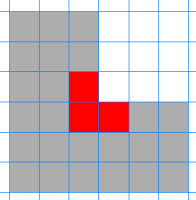 Can you find a quick way of tiling the region, using combinations of the 'building blocks' below?
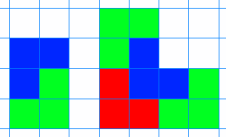
In the same way, can you find a way of adding to your size 3 tiling to tile a size 5? Then a size 7, 9, 11...? Click here for a hint.
Devise a convincing argument that you will be able to tile any odd sized L-triomino using size 1 L-triominoes.
Combine your ideas to produce a convincing argument that ANY size of L-triomino can be tiled.
Here is an interactive you could use to try out your ideas.


L-triominoes
Age 14 to 16
Challenge Level 

A triomino is a shape made from three squares. Here is an L-triomino:
Here is a size 2 L-triomino:
It can be tiled with four size 1 L-triominoes:
Can you work out how to use the tiling of a size 2 L-triomino to help you to tile a size 4 L-triomino? Click here for a hint.
Devise a convincing argument that you will be able to tile a size 8, 16, 32... $2^n$ L-triomino using size 1 L-triominoes.
How many size 1 L-triominoes would you need to tile a size 8... 16... 32... $2^n$ L-triomino?
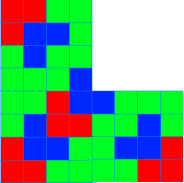
What about odd sized L-triominoes? The diagram below shows the region which needs to be tiled to turn a size 1 L-triomino into a size 3 L-triomino.
In the same way, can you find a way of adding to your size 3 tiling to tile a size 5? Then a size 7, 9, 11...? Click here for a hint.
Devise a convincing argument that you will be able to tile any odd sized L-triomino using size 1 L-triominoes.
Combine your ideas to produce a convincing argument that ANY size of L-triomino can be tiled.
Here is an interactive you could use to try out your ideas.
You may also like
Doodles
Draw a 'doodle' - a closed intersecting curve drawn without taking pencil from paper. What can you prove about the intersections?
Russian Cubes
I want some cubes painted with three blue faces and three red faces. How many different cubes can be painted like that?
Polycircles
Show that for any triangle it is always possible to construct 3 touching circles with centres at the vertices. Is it possible to construct touching circles centred at the vertices of any polygon?