Skip over navigation




L-triominoes
Age 14 to 16
Challenge Level 

Why do this problem?
This problem begins with very simple ideas about tiling and enlargement but can lead learners to appreciate how proofs can be built up in stages, through breaking an idea down into special cases. It also introduces the intriguing mathematical notion of reptiles - shapes that can be tiled to make enlargements of themselves.Possible approach
Start by introducing the
smallest L-triomino and challenge learners to find a way to tile a
size 2, 3 and 4 L-triomino with it, on squared paper. They may work
in quite a haphazard way to start off with, and may not even find
ways of tiling them all. There is the opportunity to discuss the
number of tiles needed, and to make links with work on enlargements
and similar shapes.
Once everyone has had a
go at tiling the first few L-triominoes, and successful attempts
are collected on the board for all to see, follow up with: "I wonder whether all sizes of
L-triomino can be tiled"
Suggest the need for a
systematic approach, gradually building up knowledge of how
different sizes of L-triomino can be tiled.
Ask learners to start by
considering how the tiling of the size 2 L-triomino helps in tiling
the size 4 L-triomino. Can they develop their ideas further and
suggest how they would convince someone that all size $2^n$
L-triominoes can be tiled? Bring the class together to share their
insights.
Next, introduce the odd
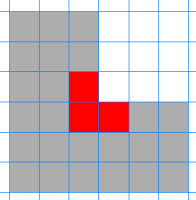
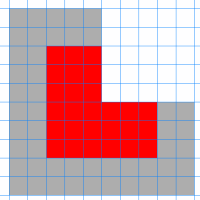
numbered sizes of L-triominoes. Share these diagrams with the
class:
Challenge learners to
find simple ways of extending their tilings from one odd number to
the next, in a way that will lead to a convincing argument that all
odd sized L-triominoes can be tiled.
Finally, learners need to
consider how the two arguments can be combined to prove that all
L-triominoes can be tiled - this is a good opportunity to discuss
the formal steps in writing down a mathematical
argument.
Key questions
How can I use my
knowledge of tiling a size 2 L-triomino to tile a size 4?
How can I use my
knowledge of tiling a size 3 L-triomino to tile a size 5?
How can I use my
knowledge of tiling odd and $2^n$ sized L-triominoes to tile
ANY size L-triomino?
Possible extension
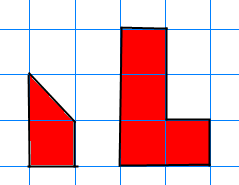
Investigate tilings with
these other reptiles:
Come up with similar
proofs that all sizes can be tiled.
Possible support
A nice way of showing how the $2^n$ sized L-triominoes can be built up is for each learner to create a size 2 L-triomino, and then to stick four of these together in their group of four to make a size 4, and then for four groups to get together to make a size 8...You may also like
Doodles
Draw a 'doodle' - a closed intersecting curve drawn without taking pencil from paper. What can you prove about the intersections?
Russian Cubes
I want some cubes painted with three blue faces and three red faces. How many different cubes can be painted like that?
Polycircles
Show that for any triangle it is always possible to construct 3 touching circles with centres at the vertices. Is it possible to construct touching circles centred at the vertices of any polygon?