Skip over navigation
Cambridge University Faculty of Mathematics NRich logo
menu search
  • Teachers expand_more
    • Early years
    • Primary
    • Secondary
    • Post-16
    • Events
    • Professional development
  • Students expand_more
    • Primary
    • Secondary
    • Post-16
  • Parents expand_more
    • Early Years
    • Primary
    • Secondary
    • Post-16
  • Problem-Solving Schools
  • About NRICH expand_more
    • About us
    • Impact stories
    • Support us
    • Our funders
    • Contact us
  • search

Or search by topic

Number and algebra

  • The Number System and Place Value
  • Calculations and Numerical Methods
  • Fractions, Decimals, Percentages, Ratio and Proportion
  • Properties of Numbers
  • Patterns, Sequences and Structure
  • Algebraic expressions, equations and formulae
  • Coordinates, Functions and Graphs

Geometry and measure

  • Angles, Polygons, and Geometrical Proof
  • 3D Geometry, Shape and Space
  • Measuring and calculating with units
  • Transformations and constructions
  • Pythagoras and Trigonometry
  • Vectors and Matrices

Probability and statistics

  • Handling, Processing and Representing Data
  • Probability

Working mathematically

  • Thinking mathematically
  • Developing positive attitudes
  • Cross-curricular contexts

Advanced mathematics

  • Decision Mathematics and Combinatorics
  • Advanced Probability and Statistics
  • Mechanics
  • Calculus

For younger learners

  • Early Years Foundation Stage

Sitting Round the Party Tables

Age 5 to 11
Challenge Level Yellow star
Primary curriculum
  • Problem
  • Getting Started
  • Student Solutions
  • Teachers' Resources

Sitting Round the Party Tables

 
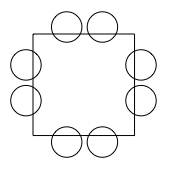
So, you are at the party and sitting around the table with seven friends.
 
 8 roundSq
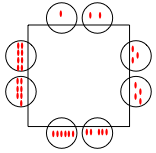
At the top left-hand corner is the friend who is giving the party. S/he has a bag of sweets and starts giving them out in a clockwise direction: one for her/himself, two for the next person and three for the next and so on.
8 sweets
There are other similar parties going on at the same time. They have bigger square tables with more children sitting round on each side.
 
Explore and compare all the tables:  2 on each side, 3 on each side, 4 on each side and $5$ on each side.
 
You could look at:
the total number of sweets that children sitting opposite each other have;
the total number of sweets needed for each size of table;
the total number of sweets belonging to children who are diagonally opposite.
 
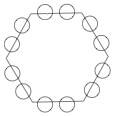
Then, what about five- and six-sided tables?
5 sides6 sides


Why do this problem?


This activity gives pupils the opportunity to explore some simple number relationships, from which they can be encouraged to make some generalisations. It may also be a good context in which to help pupils ask their own questions - "I wonder what would happen if we ...?" showing their curiosity. You will be aware that a lot of perseverance is helpful in solving this challenge. The "Teacher Support" at the bottom of this page is recommended in regard to the curiosity aspect of this task.

Possible approach


With younger pupils or those with little experience of exploration in mathematics and talking about their mathematical thoughts, it would be good to act out the problem as first described.
 
With more experienced pupils you could just present the challenge orally and ask them to explore further.  Encourage learners to write down all the things they notice.  It might also be appropriate for you to bring everyone together after some time to discuss how they are recording their work.  
 
Invite pupils to ask and begin to answer their own questions: "I wonder what would happen if I ...?".  You could use some of the suggestions in the problem itself to prompt those who may not be used to doing this.

Key questions


Tell me about what you have noticed about the numbers of sweets.
What else are you going to explore?
Tell me about what's going on at the other party tables.
Are there any special things you notice about the seats in particular places?

Possible extension


Some pupils might look at generalisations that they can say about tables of ANY size or of ANY shape.

Possible support


Some pupils may find it helpful to approach the problem using practical equipment, for example using counters to represent the sweets and having 'tables' made out of paper or card.
 

Teacher Support

This task was created to help in the pursuance of curiosity within the Mathematics lessons.
Help may be found in the realm of curiosity in watching parts of these excellent videos.
Firstly "The Rise & Fall of Curiosity", particularly the extract [23.50 - 37.15] on "adult encouragement answering and teacher behaviour."
Secondly, "The Hungry Mind: The Origins of Curiosity", particularly the extract [8.22 - 12.29]  on "Children asking questions.


First can also be found at - https://www.youtube.com/watch?v=X-0NOrIU67w
Second can also be found at https://www.youtube.com/watch?v=Wh4WAdw-oq8

You may also like

I'm Eight

Find a great variety of ways of asking questions which make 8.

Let's Investigate Triangles

Vincent and Tara are making triangles with the class construction set. They have a pile of strips of different lengths. How many different triangles can they make?
Noah

Noah saw 12 legs walk by into the Ark. How many creatures did he see?

  • Tech help
  • Accessibility Statement
  • Sign up to our newsletter
  • Twitter X logo

The NRICH Project aims to enrich the mathematical experiences of all learners. To support this aim, members of the NRICH team work in a wide range of capacities, including providing professional development for teachers wishing to embed rich mathematical tasks into everyday classroom practice.

NRICH is part of the family of activities in the Millennium Mathematics Project.

University of Cambridge logo NRICH logo