Skip over navigation
Cambridge University Faculty of Mathematics NRich logo
menu search
  • Teachers expand_more
    • Early years
    • Primary
    • Secondary
    • Post-16
    • Events
    • Professional development
  • Students expand_more
    • Primary
    • Secondary
    • Post-16
  • Parents expand_more
    • Early Years
    • Primary
    • Secondary
    • Post-16
  • Problem-Solving Schools
  • About NRICH expand_more
    • About us
    • Impact stories
    • Support us
    • Our funders
    • Contact us
  • search

Or search by topic

Number and algebra

  • The Number System and Place Value
  • Calculations and Numerical Methods
  • Fractions, Decimals, Percentages, Ratio and Proportion
  • Properties of Numbers
  • Patterns, Sequences and Structure
  • Algebraic expressions, equations and formulae
  • Coordinates, Functions and Graphs

Geometry and measure

  • Angles, Polygons, and Geometrical Proof
  • 3D Geometry, Shape and Space
  • Measuring and calculating with units
  • Transformations and constructions
  • Pythagoras and Trigonometry
  • Vectors and Matrices

Probability and statistics

  • Handling, Processing and Representing Data
  • Probability

Working mathematically

  • Thinking mathematically
  • Developing positive attitudes
  • Cross-curricular contexts

Advanced mathematics

  • Decision Mathematics and Combinatorics
  • Advanced Probability and Statistics
  • Mechanics
  • Calculus

For younger learners

  • Early Years Foundation Stage

The Add and Take-away Path

Age 5 to 7
Challenge Level Yellow star
Primary curriculum
  • Problem
  • Getting Started
  • Student Solutions
  • Teachers' Resources

The Add and Take-away Path printable sheet

Once there was a garden with lots of paths and little patches of grass between them. It looked a bit like this:
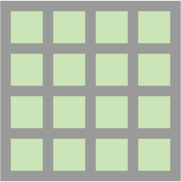
4 x 4

Two children, William and Thea, made up a game.

For every patch of grass they passed as they walked to the right on the picture, they added one.
For every patch of grass they passed as they walked to the left on the picture, they took away one.
If they went North (up on the picture), they added two for every patch of grass, and if they went South (down on the picture), they took away two for each patch of grass.


They started with ten points at S, and added and took away until they reached E.
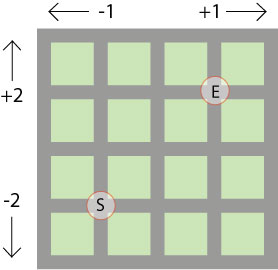
These are the paths they took:
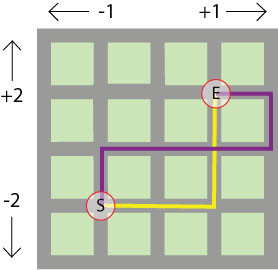
paths they took

Thea took the yellow path. Remember she started with $10$ points.
How many points did she have when she arrived at E?

William took the purple path.
How many points did he have when he arrived at E?

In the picture below, we've taken out the grass and just drawn a grid. You can imagine that the squares are patches of grass and the lines are the paths in the garden.
 
We have marked different starting and end points.
What would your score be if you walked along the blue path?  
And the red path?
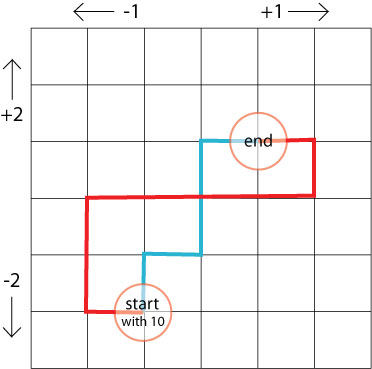
6 x 6

Make up some more paths between these start and end points.
What is your score each time?
What do you notice?
Can you explain why?

You might like to print off a copy of the grid to work on.


You may also like

Triangle Animals

How many different ways can you find to join three equilateral triangles together? Can you convince us that you have found them all?
Triple Cubes

This challenge involves eight three-cube models made from interlocking cubes. Investigate different ways of putting the models together then compare your constructions.
Order, Order!

Can you place these quantities in order from smallest to largest?

  • Tech help
  • Accessibility Statement
  • Sign up to our newsletter
  • Twitter X logo

The NRICH Project aims to enrich the mathematical experiences of all learners. To support this aim, members of the NRICH team work in a wide range of capacities, including providing professional development for teachers wishing to embed rich mathematical tasks into everyday classroom practice.

NRICH is part of the family of activities in the Millennium Mathematics Project.

University of Cambridge logo NRICH logo