
Skip over navigation
Cambridge University Faculty of Mathematics NRich logo
menu search
  • Teachers expand_more
    • Early years
    • Primary
    • Secondary
    • Post-16
    • Events
    • Professional development
  • Students expand_more
    • Primary
    • Secondary
    • Post-16
  • Parents expand_more
    • Early Years
    • Primary
    • Secondary
    • Post-16
  • Problem-Solving Schools
  • About NRICH expand_more
    • About us
    • Impact stories
    • Support us
    • Our funders
    • Contact us
  • search

Or search by topic

Number and algebra

  • The Number System and Place Value
  • Calculations and Numerical Methods
  • Fractions, Decimals, Percentages, Ratio and Proportion
  • Properties of Numbers
  • Patterns, Sequences and Structure
  • Algebraic expressions, equations and formulae
  • Coordinates, Functions and Graphs

Geometry and measure

  • Angles, Polygons, and Geometrical Proof
  • 3D Geometry, Shape and Space
  • Measuring and calculating with units
  • Transformations and constructions
  • Pythagoras and Trigonometry
  • Vectors and Matrices

Probability and statistics

  • Handling, Processing and Representing Data
  • Probability

Working mathematically

  • Thinking mathematically
  • Developing positive attitudes
  • Cross-curricular contexts

Advanced mathematics

  • Decision Mathematics and Combinatorics
  • Advanced Probability and Statistics
  • Mechanics
  • Calculus

For younger learners

  • Early Years Foundation Stage

Counting Dolphins

Age 14 to 16
Challenge Level Yellow star
  • Problem
  • Student Solutions
  • Teachers' Resources


  • Warm-up
  • Try this next
  • Think higher
  • Read: mathematics
  • Read: science
  • Explore further


If you were a scientist studying dolphins how might you try to estimate how many dolphins were in an ocean?
 
One way of doing this is to count the number of dolphins in a certain area and then take this as the population density for the whole ocean, eg. if there were 5 dolphins in 10 $km^{3}$ you could use this to estimate that there would be 500 dolphins in 1000 $km^{3}$ of water. Can you think of any problems with this approach? What assumptions does it make? Do you think that they are valid?
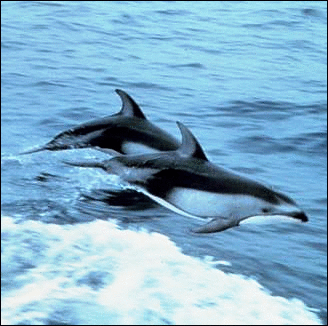
 
Another possible method is to capture dolphins over a period of time, tag them and release them. You can then catch another set of dolphins and see how many of them are tagged. For example, you could catch 100 dolphins from the wild and tag them before releasing them where they were caught. If you then catch another 100 dolphins and find that 5 of them had been tagged you could estimate that because $\frac{5}{100}$ dolphins in your sample were tagged, 5% of all dolphins had been tagged. You tagged 100 dolphins so if this were true there would be $\frac{100}{0.05}$ = 2000 dolphins in total. What assumptions does this method rely on?
 
Which of the two methods do you think is better? Is one always better than the other or are there some conditions (eg size of ocean, size of total dolphin population) that might favour the other better?  Can you think of any ways to improve these approaches?


You may also like
bioNRICH

bioNRICH is the area of the stemNRICH site devoted to the mathematics underlying the study of the biological sciences, designed to help develop the mathematics required to get the most from your study of biology at A-level and university.

More or Less?

Are these estimates of physical quantities accurate?

Time to Evolve

How many generations would link an evolutionist to a very distant ancestor?

  • Tech help
  • Accessibility Statement
  • Sign up to our newsletter
  • Twitter X logo

The NRICH Project aims to enrich the mathematical experiences of all learners. To support this aim, members of the NRICH team work in a wide range of capacities, including providing professional development for teachers wishing to embed rich mathematical tasks into everyday classroom practice.

NRICH is part of the family of activities in the Millennium Mathematics Project.

University of Cambridge logo NRICH logo