Skip over navigation
Cambridge University Faculty of Mathematics NRich logo
menu search
  • Teachers expand_more
    • Early years
    • Primary
    • Secondary
    • Post-16
    • Events
    • Professional development
  • Students expand_more
    • Primary
    • Secondary
    • Post-16
  • Parents expand_more
    • Early Years
    • Primary
    • Secondary
    • Post-16
  • Problem-Solving Schools
  • About NRICH expand_more
    • About us
    • Impact stories
    • Support us
    • Our funders
    • Contact us
  • search

Or search by topic

Number and algebra

  • The Number System and Place Value
  • Calculations and Numerical Methods
  • Fractions, Decimals, Percentages, Ratio and Proportion
  • Properties of Numbers
  • Patterns, Sequences and Structure
  • Algebraic expressions, equations and formulae
  • Coordinates, Functions and Graphs

Geometry and measure

  • Angles, Polygons, and Geometrical Proof
  • 3D Geometry, Shape and Space
  • Measuring and calculating with units
  • Transformations and constructions
  • Pythagoras and Trigonometry
  • Vectors and Matrices

Probability and statistics

  • Handling, Processing and Representing Data
  • Probability

Working mathematically

  • Thinking mathematically
  • Developing positive attitudes
  • Cross-curricular contexts

Advanced mathematics

  • Decision Mathematics and Combinatorics
  • Advanced Probability and Statistics
  • Mechanics
  • Calculus

For younger learners

  • Early Years Foundation Stage

Which Is Bigger?

Age 14 to 16
Challenge Level Yellow starYellow star
Secondary curriculum
  • Problem
  • Getting Started
  • Student Solutions
  • Teachers' Resources


Why do this problem?

This problem highlights the importance of variables in algebraic expressions, and offers opportunities to explore straight line graphs and simple inequalities. By switching between numerical, algebraic and graphical representations, students can gain insights into the effects of changing a variable. The last part of the problem encourages a playful curiosity where students can experiment with graphing software to try to solve each challenge.


Possible approach

Start the lesson by posing the question:

"Which is bigger, $n+10$, or $2n+3$?"

 
Give students a short amount of time to decide, and then ask them to discuss the justification for their answer in pairs. Look out for any pairs using a graphical argument to support their conclusions.
 
Share these discussions as a class. (If everyone agrees that one particular expression is bigger, use the reasoning in the problem to generate some controversy.) 
 
"Is there any way we could represent what's going on graphically, to convince ourselves that the first expression is bigger when $n< 7$ and the second expression is bigger when $n> 7$?"
 
Once there is an understanding that comparison of the expressions depends on the variable $n$, and that the comparison can be done graphically, set the next task:
 
"For each pair, can you work out when each expression is bigger?" Hand out the worksheet: Which Is Bigger?
 
Again, give students time to work on this in pairs, making sure they are ready to justify their answers using the insights they have gained.
 
Finally, set them to work on the challenges offered at the bottom of the problem. One nice way to round off the task could be to plot the graphs on a computer (perhaps using Desmos) and ask each pair of students to read out the expressions they have found.

As the expressions are plotted, the class can decide whether they satisfy the requirements. In order to capture the idea that there are infinitely many sets of expressions that satisfy each condition, students could suggest tweaks to the functions that would still satisfy the conditions.
 

Key questions

Is one expression always bigger?
How can you decide when each expression is bigger?
Would it help to express the relationship graphically?
 

Possible support

Which Is Cheaper? might be a more accessible starting point, as it uses concrete examples rather than abstract expressions. 
 

Possible extension

Introduce challenges that require quadratic expressions as well as linear ones.
For example:
"Can you find two expressions so that the first is bigger for $n< 0$ and $n> 3$, but the second is bigger when $n$ is between $0$ and $3$?"


You may also like

Ladder and Cube

A 1 metre cube has one face on the ground and one face against a wall. A 4 metre ladder leans against the wall and just touches the cube. How high is the top of the ladder above the ground?

Doesn't Add Up

In this problem we are faced with an apparently easy area problem, but it has gone horribly wrong! What happened?
From All Corners

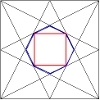
Straight lines are drawn from each corner of a square to the mid points of the opposite sides. Express the area of the octagon that is formed at the centre as a fraction of the area of the square.

  • Tech help
  • Accessibility Statement
  • Sign up to our newsletter
  • Twitter X logo

The NRICH Project aims to enrich the mathematical experiences of all learners. To support this aim, members of the NRICH team work in a wide range of capacities, including providing professional development for teachers wishing to embed rich mathematical tasks into everyday classroom practice.

NRICH is part of the family of activities in the Millennium Mathematics Project.

University of Cambridge logo NRICH logo