
Skip over navigation
Cambridge University Faculty of Mathematics NRich logo
menu search
  • Teachers expand_more
    • Early years
    • Primary
    • Secondary
    • Post-16
    • Events
    • Professional development
  • Students expand_more
    • Primary
    • Secondary
    • Post-16
  • Parents expand_more
    • Early Years
    • Primary
    • Secondary
    • Post-16
  • Problem-Solving Schools
  • About NRICH expand_more
    • About us
    • Impact stories
    • Support us
    • Our funders
    • Contact us
  • search

Or search by topic

Number and algebra

  • The Number System and Place Value
  • Calculations and Numerical Methods
  • Fractions, Decimals, Percentages, Ratio and Proportion
  • Properties of Numbers
  • Patterns, Sequences and Structure
  • Algebraic expressions, equations and formulae
  • Coordinates, Functions and Graphs

Geometry and measure

  • Angles, Polygons, and Geometrical Proof
  • 3D Geometry, Shape and Space
  • Measuring and calculating with units
  • Transformations and constructions
  • Pythagoras and Trigonometry
  • Vectors and Matrices

Probability and statistics

  • Handling, Processing and Representing Data
  • Probability

Working mathematically

  • Thinking mathematically
  • Developing positive attitudes
  • Cross-curricular contexts

Advanced mathematics

  • Decision Mathematics and Combinatorics
  • Advanced Probability and Statistics
  • Mechanics
  • Calculus

For younger learners

  • Early Years Foundation Stage

A Very Shiny Nose?

Age 16 to 18
Challenge Level Yellow starYellow star
  • Problem
  • Getting Started
  • Student Solutions
  • Teachers' Resources

Why use this problem?

This problem is based on real-life biology, and also includes the concept of half-life.  Students will need to decide how to use the information that they are given, and will need to do some estimating.

The idea of bounds is very useful here.  Students can try to find a number for $X$ which they know is an underestimate.  They can also try and find an overestimate for the volume of Rudolph's nose.

You can download a word and pdf version of this problem.

Key Questions

  • What do we know?  What do we not know, which we need to know?
  • How might we estimate what we don't know?
  • How many bacteria do we have after 30 minutes?  How many after 1 hour?  How many at the end of the 24 hours?
  • If we have $n$ bacteria, how many molecules of $X$ will have been emitted during a 10 minute period?  Can you find an underestimate for the number of molecules of $X$ left at the end of the 10 minutes, assuming that the half life is 10 minutes.
  • If we think of the molecules of $X$ emitted near the start of the 24 hours, most of them will have decayed by the end of the day, which means we can ignore any early molecules.  At what point should we stop ignoring them?


This website gives the sizes of various sports ball which might be useful.

Possible Extension

Can you find an upper limit for the size of Rudolph's nose? 

You may also like
Ball Bearings

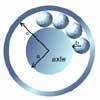
If a is the radius of the axle, b the radius of each ball-bearing, and c the radius of the hub, why does the number of ball bearings n determine the ratio c/a? Find a formula for c/a in terms of n.
Air Routes

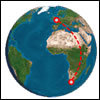
Find the distance of the shortest air route at an altitude of 6000 metres between London and Cape Town given the latitudes and longitudes. A simple application of scalar products of vectors.

Over-booking

The probability that a passenger books a flight and does not turn up is 0.05. For an aeroplane with 400 seats how many tickets can be sold so that only 1% of flights are over-booked?

  • Tech help
  • Accessibility Statement
  • Sign up to our newsletter
  • Twitter X logo

The NRICH Project aims to enrich the mathematical experiences of all learners. To support this aim, members of the NRICH team work in a wide range of capacities, including providing professional development for teachers wishing to embed rich mathematical tasks into everyday classroom practice.

NRICH is part of the family of activities in the Millennium Mathematics Project.

University of Cambridge logo NRICH logo