Skip over navigation
Cambridge University Faculty of Mathematics NRich logo
menu search
  • Teachers expand_more
    • Early years
    • Primary
    • Secondary
    • Post-16
    • Events
    • Professional development
  • Students expand_more
    • Primary
    • Secondary
    • Post-16
  • Parents expand_more
    • Early Years
    • Primary
    • Secondary
    • Post-16
  • Problem-Solving Schools
  • About NRICH expand_more
    • About us
    • Impact stories
    • Support us
    • Our funders
    • Contact us
  • search

Or search by topic

Number and algebra

  • The Number System and Place Value
  • Calculations and Numerical Methods
  • Fractions, Decimals, Percentages, Ratio and Proportion
  • Properties of Numbers
  • Patterns, Sequences and Structure
  • Algebraic expressions, equations and formulae
  • Coordinates, Functions and Graphs

Geometry and measure

  • Angles, Polygons, and Geometrical Proof
  • 3D Geometry, Shape and Space
  • Measuring and calculating with units
  • Transformations and constructions
  • Pythagoras and Trigonometry
  • Vectors and Matrices

Probability and statistics

  • Handling, Processing and Representing Data
  • Probability

Working mathematically

  • Thinking mathematically
  • Developing positive attitudes
  • Cross-curricular contexts

Advanced mathematics

  • Decision Mathematics and Combinatorics
  • Advanced Probability and Statistics
  • Mechanics
  • Calculus

For younger learners

  • Early Years Foundation Stage

Discuss and Choose

Age 5 to 11
Challenge Level Yellow star
Primary curriculum
  • Problem
  • Getting Started
  • Student Solutions
  • Teachers' Resources

Discuss and Choose


This activity challenges you to decide on the 'best' number to use in each of the following statements.
 
You may like to talk to someone else about what you're thinking.  You may need to do some estimating, some calculating and some research.
 
Please send us your solutions and don't forget to explain how you arrived at your conclusions.

 
 
 catA
1) There are roughly $10/500/1000$ million domestic cats in the world.
2) On average, cats weigh $1.5/4.5/8$ kg.
3) Domestic cats sleep on average $8-9/13-14/18-19$ hours a day.

 
 DogA
4) There are roughly $400/600/800$ million domestic dogs in the world.
5) The average life of a dog is $10-14/14-18/18-20$ years.

 
 
 DolphinA
6) Dolphins live in groups called pods or schools of up to $12/20/30$ individuals.
 
 ElephantA
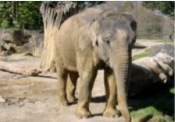
7) Adult elephants need to drink about $100/200/400$ litres of water a day.
 
 GiraffeA
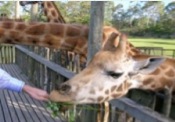
8) A giraffe's neck is about $120/170/220$ cm long.
9) A giraffe's tail hair is $2/5/10$ times as thick as the average human hair.

 
 LionA
10) On average, male lions weigh $180/250/330$ kg.
11) A lion's roar can be heard $8/12/16$  kms away.
12) On average, lions rest for $10/15/20$ hours a day.


Why do this problem?

This activity gives an opportunity to discuss the quantities involved in the statements, and may involve estimation, calculation and/or research. Children will rely not only on what they have learnt from school, but also on information they have picked up from elsewhere. The discussion may well reveal some surprises, particularly in terms of their understanding of different units of measurement. 

Possible approach

The activity could be suitable for small group or whole class discussions, depending on the experiences of the children involved.  You might find it helpful to print off copies of this sheet which has all the statements on it.   The statements could be cut up so that each is on a separate card. 
 
The role of the adult in this kind of situation is to enable discussion to take place effectively.  It may be that after an initial discussion about each statement, you assign a pair or small group of children a few statements each and invite them to come up with evidence to support their suggested answer.   If possible, encourage them to record as they go along so that they have a reminder of what they did.

Key questions

So, what do "you" think about what "they" have just said?
Tell us your thoughts about ...
So, what do you all think?
Do some of you agree with ...?
If so, why?  Or why not?
How could we be more sure?

Possible extension

Youngsters could create their own challenges in a similar way for others to discuss.

Possible support

Try to help by listening, sharing and offering thoughts where appropriate.  

You may also like

Next Size Up

The challenge for you is to make a string of six (or more!) graded cubes.

Area and Perimeter

What can you say about these shapes? This problem challenges you to create shapes with different areas and perimeters.
Order, Order!

Can you place these quantities in order from smallest to largest?

  • Tech help
  • Accessibility Statement
  • Sign up to our newsletter
  • Twitter X logo

The NRICH Project aims to enrich the mathematical experiences of all learners. To support this aim, members of the NRICH team work in a wide range of capacities, including providing professional development for teachers wishing to embed rich mathematical tasks into everyday classroom practice.

NRICH is part of the family of activities in the Millennium Mathematics Project.

University of Cambridge logo NRICH logo