Skip over navigation

Cambridge University Faculty of Mathematics NRich logo
menu search
  • Teachers expand_more
    • Early years
    • Primary
    • Secondary
    • Post-16
    • Events
    • Professional development
  • Students expand_more
    • Primary
    • Secondary
    • Post-16
  • Parents expand_more
    • Early Years
    • Primary
    • Secondary
    • Post-16
  • Problem-Solving Schools
  • About NRICH expand_more
    • About us
    • Impact stories
    • Support us
    • Our funders
    • Contact us
  • search

Or search by topic

Number and algebra

  • The Number System and Place Value
  • Calculations and Numerical Methods
  • Fractions, Decimals, Percentages, Ratio and Proportion
  • Properties of Numbers
  • Patterns, Sequences and Structure
  • Algebraic expressions, equations and formulae
  • Coordinates, Functions and Graphs

Geometry and measure

  • Angles, Polygons, and Geometrical Proof
  • 3D Geometry, Shape and Space
  • Measuring and calculating with units
  • Transformations and constructions
  • Pythagoras and Trigonometry
  • Vectors and Matrices

Probability and statistics

  • Handling, Processing and Representing Data
  • Probability

Working mathematically

  • Thinking mathematically
  • Developing positive attitudes
  • Cross-curricular contexts

Advanced mathematics

  • Decision Mathematics and Combinatorics
  • Advanced Probability and Statistics
  • Mechanics
  • Calculus

For younger learners

  • Early Years Foundation Stage

Rhombus in Rectangle

Age 14 to 16
Challenge Level Yellow starYellow star
  • Problem
  • Getting Started
  • Student Solutions
  • Teachers' Resources

Why do this problem?

This problem allows students to gain an understanding of a geometrical situation by using an algebraic representation. It can be approached numerically at first and then generalised. The problem can be used to practise expansion of brackets, changing the subject of a formula, fractions and surds, as well as the application of Pythagoras' theorem.

Possible approach

Start with a particular rectangle, for example 6 units by 4 units. If I positioned$Q$ 1 unit from$D$, would it be a rhombus? Using Pythagoras, show that $AQ$ and $QC$ would not be equal.By calling the distance $QC$ $x$, students could try to write down an equation which must be true for the shape to be a rhombus, that is for $AQ=QC$. By rearranging to make $x$ the subject, students should be able to justify the statement that there is only one possible value of $x$.

It may be necessary to try other numerical examples before generalising, but once a general form is found linking $x$ with the base and height of the rectangle, the rest of the problem can be tackled.

Key questions

What must be true about the lengths $DQ$ and $PB$?
What must be true about the lengths $AQ$ and $QC$?
What happens to the length of $AQ$ as I move $Q$ further from $D$?


Possible extension

Consider what would happen if we constructed the shape on the shorter sides of the rectangle.

Possible support

Some learners may find it easier to tackle the problem using Trial and Improvement.


You may also like

At a Glance

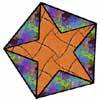
The area of a regular pentagon looks about twice as a big as the pentangle star drawn within it. Is it?

Six Discs

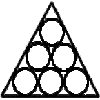
Six circular discs are packed in different-shaped boxes so that the discs touch their neighbours and the sides of the box. Can you put the boxes in order according to the areas of their bases?

Equilateral Areas

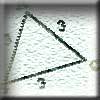
ABC and DEF are equilateral triangles of side 3 and 4 respectively. Construct an equilateral triangle whose area is the sum of the area of ABC and DEF.

  • Tech help
  • Accessibility Statement
  • Sign up to our newsletter
  • Twitter X logo

The NRICH Project aims to enrich the mathematical experiences of all learners. To support this aim, members of the NRICH team work in a wide range of capacities, including providing professional development for teachers wishing to embed rich mathematical tasks into everyday classroom practice.

NRICH is part of the family of activities in the Millennium Mathematics Project.

University of Cambridge logo NRICH logo