
Skip over navigation
Cambridge University Faculty of Mathematics NRich logo
menu search
  • Teachers expand_more
    • Early years
    • Primary
    • Secondary
    • Post-16
    • Events
    • Professional development
  • Students expand_more
    • Primary
    • Secondary
    • Post-16
  • Parents expand_more
    • Early Years
    • Primary
    • Secondary
    • Post-16
  • Problem-Solving Schools
  • About NRICH expand_more
    • About us
    • Impact stories
    • Support us
    • Our funders
    • Contact us
  • search

Or search by topic

Number and algebra

  • The Number System and Place Value
  • Calculations and Numerical Methods
  • Fractions, Decimals, Percentages, Ratio and Proportion
  • Properties of Numbers
  • Patterns, Sequences and Structure
  • Algebraic expressions, equations and formulae
  • Coordinates, Functions and Graphs

Geometry and measure

  • Angles, Polygons, and Geometrical Proof
  • 3D Geometry, Shape and Space
  • Measuring and calculating with units
  • Transformations and constructions
  • Pythagoras and Trigonometry
  • Vectors and Matrices

Probability and statistics

  • Handling, Processing and Representing Data
  • Probability

Working mathematically

  • Thinking mathematically
  • Developing positive attitudes
  • Cross-curricular contexts

Advanced mathematics

  • Decision Mathematics and Combinatorics
  • Advanced Probability and Statistics
  • Mechanics
  • Calculus

For younger learners

  • Early Years Foundation Stage

Round a Hexagon

Age 7 to 11
Challenge Level Yellow star
Primary curriculum
  • Problem
  • Getting Started
  • Student Solutions
  • Teachers' Resources

This activity proved to be a little tricky for many pupils so maybe some more thoughts need to be given about external and internal angles. What also made it harder was asking for some suggestions about proving the solution offered.

However, from Rebecca at the  Baden Powell School in the UK we had this really good solution sent in.


If she went round every angle once when she went round the last angle she would be facing the way she started. She could also do this with a square or rectangle.
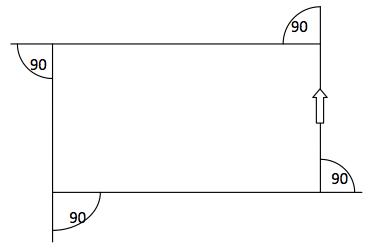

$90+90+90+90=360$


It also works with any triangle, because she always faces the same way when she gets back to the start.
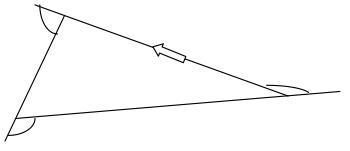
 

All shapes outer angles will add up to $360 °$ because Brenda always faces the same way when she gets back to the start.


From SooyoungӬ who said they went to GCMSӬ which I assume is Gosforth Central Middle School in the U.K.Ӭ we had the following interesting suggestion:


If you shrank the hexagon as small as a dot, the exterior angle would look like a rough circle which has 360 degrees altogether.


SophiaӬ at Towcester C E Primary School send in this thought of hers:


I think the answer is 360 degrees becuse the dot goes the whole way round and ended up facing the same way as it started. I added up $90, 90, 90$ and $90$ and it added up to $360$ degrees for a square a hexagon and a triangle.


So, thank you for those and I hope that there wil be even more learning about angles and shapes for us all.


You may also like

Tea Cups

Place the 16 different combinations of cup/saucer in this 4 by 4 arrangement so that no row or column contains more than one cup or saucer of the same colour.
Exploring Wild & Wonderful Number Patterns

EWWNP means Exploring Wild and Wonderful Number Patterns Created by Yourself! Investigate what happens if we create number patterns using some simple rules.

Cubes

How many faces can you see when you arrange these three cubes in different ways?

  • Tech help
  • Accessibility Statement
  • Sign up to our newsletter
  • Twitter X logo

The NRICH Project aims to enrich the mathematical experiences of all learners. To support this aim, members of the NRICH team work in a wide range of capacities, including providing professional development for teachers wishing to embed rich mathematical tasks into everyday classroom practice.

NRICH is part of the family of activities in the Millennium Mathematics Project.

University of Cambridge logo NRICH logo