Skip over navigation


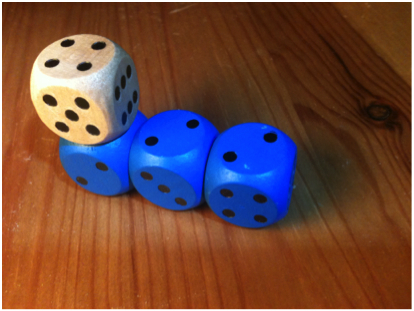
This dice model represents an old blue steam train with a white funnel on the engine at the front. The dice that make up the train are joined using three rules.
RULE 1: Faces that touch each other have the same number.
So, underneath the white dice is a $3$ touching a $3$ on the blue dice.
The blue dice has a $6$ on the face that touches the $6$ on the middle blue dice.
The middle blue dice has a $1$ that touches the $1$ on the last dice.
RULE 2: The number on the top of the funnel must equal the total of the numbers showing on top of the remaining dice (carriages) that can be seen.
So, the $4$ on top of the funnel equals the two $2$'s on top of the blue carriages.
RULE 3: Always use four or more dice - so you have at least two 'carriage numbers' to add up.
Obeying all the rules, how many solutions are possible?
You can make models like this one or you could make it longer.
Each one you make is to have the funnel on top of the front dice.
This problem featured in a preliminary round of the Young Mathematicians' Award.

The Dice Train
Age 7 to 11
Challenge Level 
This dice model represents an old blue steam train with a white funnel on the engine at the front. The dice that make up the train are joined using three rules.
RULE 1: Faces that touch each other have the same number.
So, underneath the white dice is a $3$ touching a $3$ on the blue dice.
The blue dice has a $6$ on the face that touches the $6$ on the middle blue dice.
The middle blue dice has a $1$ that touches the $1$ on the last dice.
RULE 2: The number on the top of the funnel must equal the total of the numbers showing on top of the remaining dice (carriages) that can be seen.
So, the $4$ on top of the funnel equals the two $2$'s on top of the blue carriages.
RULE 3: Always use four or more dice - so you have at least two 'carriage numbers' to add up.
YOUR CHALLENGE
Obeying all the rules, how many solutions are possible?
You can make models like this one or you could make it longer.
Each one you make is to have the funnel on top of the front dice.
This problem featured in a preliminary round of the Young Mathematicians' Award.
You may also like
Prompt Cards
These two group activities use mathematical reasoning - one is numerical, one geometric.
Consecutive Numbers
An investigation involving adding and subtracting sets of consecutive numbers. Lots to find out, lots to explore.
Exploring Wild & Wonderful Number Patterns
EWWNP means Exploring Wild and Wonderful Number Patterns Created by Yourself! Investigate what happens if we create number patterns using some simple rules.