Skip over navigation
Cambridge University Faculty of Mathematics NRich logo
menu search
  • Teachers expand_more
    • Early years
    • Primary
    • Secondary
    • Post-16
    • Events
    • Professional development
  • Students expand_more
    • Primary
    • Secondary
    • Post-16
  • Parents expand_more
    • Early Years
    • Primary
    • Secondary
    • Post-16
  • Problem-Solving Schools
  • About NRICH expand_more
    • About us
    • Impact stories
    • Support us
    • Our funders
    • Contact us
  • search

Or search by topic

Number and algebra

  • The Number System and Place Value
  • Calculations and Numerical Methods
  • Fractions, Decimals, Percentages, Ratio and Proportion
  • Properties of Numbers
  • Patterns, Sequences and Structure
  • Algebraic expressions, equations and formulae
  • Coordinates, Functions and Graphs

Geometry and measure

  • Angles, Polygons, and Geometrical Proof
  • 3D Geometry, Shape and Space
  • Measuring and calculating with units
  • Transformations and constructions
  • Pythagoras and Trigonometry
  • Vectors and Matrices

Probability and statistics

  • Handling, Processing and Representing Data
  • Probability

Working mathematically

  • Thinking mathematically
  • Developing positive attitudes
  • Cross-curricular contexts

Advanced mathematics

  • Decision Mathematics and Combinatorics
  • Advanced Probability and Statistics
  • Mechanics
  • Calculus

For younger learners

  • Early Years Foundation Stage
NRICH topics: Algebraic expressions, equations and formulae Other equations

Resources tagged with: Other equations

Content type:
Age range:
Challenge level:

There are 21 NRICH Mathematical resources connected to Other equations, you may find related items under Algebraic expressions, equations and formulae.

Broad Topics > Algebraic expressions, equations and formulae > Other equations

Problem Primary curriculum Secondary curriculum

One and Three

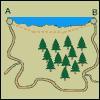
Two motorboats travelling up and down a lake at constant speeds leave opposite ends A and B at the same instant, passing each other, for the first time 600 metres from A, and on their return, 400 metres from B. How long is the lake?

Age 14 to 16
Challenge Level Yellow starYellow star
Problem Primary curriculum Secondary curriculum

Root to Poly

Find the polynomial p(x) with integer coefficients such that one solution of the equation p(x)=0 is $1+\sqrt 2+\sqrt 3$.
Age 14 to 16
Challenge Level Yellow starYellow starYellow star
Problem Primary curriculum Secondary curriculum

Polynomial Relations

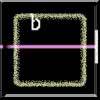
Given any two polynomials in a single variable it is always possible to eliminate the variable and obtain a formula showing the relationship between the two polynomials. Try this one.
Age 16 to 18
Challenge Level Yellow star
Problem Primary curriculum Secondary curriculum

N Is a Number

N people visit their friends staying N kilometres along the coast. Some walk along the cliff path at N km an hour, the rest go by car. How long is the road?
Age 11 to 14
Challenge Level Yellow starYellow starYellow star
Problem Primary curriculum Secondary curriculum

Golden Ratio

Solve an equation involving the Golden Ratio phi where the unknown occurs as a power of phi.
Age 16 to 18
Challenge Level Yellow starYellow starYellow star
Problem Primary curriculum Secondary curriculum

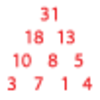
Top-heavy Pyramids

Use the numbers in the box below to make the base of a top-heavy pyramid whose top number is 200.
Age 11 to 14
Challenge Level Yellow starYellow starYellow star
Problem Primary curriculum Secondary curriculum

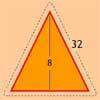
Are You Kidding

If the altitude of an isosceles triangle is 8 units and the perimeter of the triangle is 32 units.... What is the area of the triangle?
Age 14 to 16
Challenge Level Yellow starYellow star
Problem Primary curriculum Secondary curriculum

Deep Roots

Find integer solutions to: $\sqrt{a+b\sqrt{x}} + \sqrt{c+d.\sqrt{x}}=1$

Age 14 to 16
Challenge Level Yellow starYellow starYellow star
Problem Primary curriculum Secondary curriculum

Around and Back

A cyclist and a runner start off simultaneously around a race track each going at a constant speed. The cyclist goes all the way around and then catches up with the runner. He then instantly turns around and heads back to the starting point where he meets the runner who is just finishing his first circuit. Find the ratio of their speeds.
Age 14 to 16
Challenge Level Yellow starYellow starYellow star
Problem Primary curriculum Secondary curriculum

Plutarch's Boxes

According to Plutarch, the Greeks found all the rectangles with integer sides, whose areas are equal to their perimeters. Can you find them? What rectangular boxes, with integer sides, have their surface areas equal to their volumes?
Age 11 to 14
Challenge Level Yellow starYellow star
Problem Primary curriculum Secondary curriculum

Three Four Five

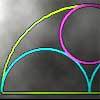
Two semi-circles (each of radius 1/2) touch each other, and a semi-circle of radius 1 touches both of them. Find the radius of the circle which touches all three semi-circles.

Age 14 to 16
Challenge Level Yellow starYellow star
Problem Primary curriculum Secondary curriculum

Hike and Hitch

Fifteen students had to travel 60 miles. They could use a car, which could only carry 5 students. As the car left with the first 5 (at 40 miles per hour), the remaining 10 commenced hiking along the road (at 4 miles per hour)...
Age 14 to 16
Challenge Level Yellow starYellow starYellow star
Problem Primary curriculum Secondary curriculum

How Big?

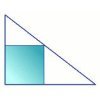
If the sides of the triangle in the diagram are 3, 4 and 5, what is the area of the shaded square?

Age 11 to 14
Challenge Level Yellow starYellow star
Problem Primary curriculum Secondary curriculum

Hand Swap

My train left London between 6 a.m. and 7 a.m. and arrived in Paris between 9 a.m. and 10 a.m. At the start and end of the journey the hands on my watch were in exactly the same positions but the minute hand and hour hand had swopped places. What time did the train leave London and how long did the journey take?

Age 14 to 16
Challenge Level Yellow starYellow star
Problem Primary curriculum Secondary curriculum

Not a Polite Question

When asked how old she was, the teacher replied: My age in years is not prime but odd and when reversed and added to my age you have a perfect square...

Age 11 to 14
ShortChallenge Level Yellow starYellow star
Problem Primary curriculum Secondary curriculum

Coffee

To make 11 kilograms of this blend of coffee costs £15 per kilogram. The blend uses more Brazilian, Kenyan and Mocha coffee... How many kilograms of each type of coffee are used?

Age 14 to 16
Challenge Level Yellow starYellow star
Problem Primary curriculum Secondary curriculum

Our Ages

I am exactly n times my daughter's age. In m years I shall be ... How old am I?
Age 14 to 16
Challenge Level Yellow star
Problem Primary curriculum Secondary curriculum

Old Nuts

In turn 4 people throw away three nuts from a pile and hide a quarter of the remainder finally leaving a multiple of 4 nuts. How many nuts were at the start?
Age 16 to 18
Challenge Level Yellow star
Problem Primary curriculum Secondary curriculum

Rudolff's Problem

A group of 20 people pay a total of £20 to see an exhibition. The admission price is £3 for men, £2 for women and 50p for children. How many men, women and children are there in the group?
Age 14 to 16
Challenge Level Yellow star
Problem Primary curriculum Secondary curriculum

Building Tetrahedra

Can you make a tetrahedron whose faces all have the same perimeter?
Age 14 to 16
Challenge Level Yellow starYellow star
Problem Primary curriculum Secondary curriculum

Real(ly) Numbers

If x, y and z are real numbers such that: x + y + z = 5 and xy + yz + zx = 3. What is the largest value that any of the numbers can have?

Age 16 to 18
Challenge Level Yellow starYellow star

  • Tech help
  • Accessibility Statement
  • Sign up to our newsletter
  • Twitter X logo

The NRICH Project aims to enrich the mathematical experiences of all learners. To support this aim, members of the NRICH team work in a wide range of capacities, including providing professional development for teachers wishing to embed rich mathematical tasks into everyday classroom practice.

NRICH is part of the family of activities in the Millennium Mathematics Project.

University of Cambridge logo NRICH logo