Skip over navigation
Cambridge University Faculty of Mathematics NRich logo
menu search
  • Teachers expand_more
    • Early years
    • Primary
    • Secondary
    • Post-16
    • Events
    • Professional development
  • Students expand_more
    • Primary
    • Secondary
    • Post-16
  • Parents expand_more
    • Early Years
    • Primary
    • Secondary
    • Post-16
  • Problem-Solving Schools
  • About NRICH expand_more
    • About us
    • Impact stories
    • Support us
    • Our funders
    • Contact us
  • search

Or search by topic

Number and algebra

  • The Number System and Place Value
  • Calculations and Numerical Methods
  • Fractions, Decimals, Percentages, Ratio and Proportion
  • Properties of Numbers
  • Patterns, Sequences and Structure
  • Algebraic expressions, equations and formulae
  • Coordinates, Functions and Graphs

Geometry and measure

  • Angles, Polygons, and Geometrical Proof
  • 3D Geometry, Shape and Space
  • Measuring and calculating with units
  • Transformations and constructions
  • Pythagoras and Trigonometry
  • Vectors and Matrices

Probability and statistics

  • Handling, Processing and Representing Data
  • Probability

Working mathematically

  • Thinking mathematically
  • Developing positive attitudes
  • Cross-curricular contexts

Advanced mathematics

  • Decision Mathematics and Combinatorics
  • Advanced Probability and Statistics
  • Mechanics
  • Calculus

For younger learners

  • Early Years Foundation Stage
NRICH topics: Handling, processing and representing data Venn diagrams

Resources tagged with: Venn diagrams

Content type:
Age range:
Challenge level:

There are 10 NRICH Mathematical resources connected to Venn diagrams, you may find related items under Handling, processing and representing data.

Broad Topics > Handling, processing and representing data > Venn diagrams

Problem Primary curriculum Secondary curriculum

Data Shapes

Sara and Will were sorting some pictures of shapes on cards. "I'll collect the circles," said Sara. "I'll take the red ones," answered Will. Can you see any cards they would both want?

Age 5 to 7
Challenge Level Yellow star
Problem Primary curriculum Secondary curriculum

Venn Diagrams

How will you complete these interactive Venn diagrams?

Age 5 to 11
Challenge Level Yellow star
Problem Primary curriculum Secondary curriculum

Plants

Three children are going to buy some plants for their birthdays. They will plant them within circular paths. How could they do this?
Age 5 to 14
Challenge Level Yellow starYellow star
Problem Primary curriculum Secondary curriculum

Data Duos

Can you match the Venn diagram with the Carroll diagram that shows the same information?

Age 7 to 11
Challenge Level Yellow star
Problem Primary curriculum Secondary curriculum

Clubs

How many students are in the maths club and the science club?

Age 11 to 14
ShortChallenge Level Yellow starYellow star
Problem Primary curriculum Secondary curriculum

Rain

How many dry days did Aisha have on her holiday?

Age 11 to 14
ShortChallenge Level Yellow starYellow starYellow star
Problem Primary curriculum Secondary curriculum

More Plant Spaces

This challenging activity involves finding different ways to distribute fifteen items among four sets, when the sets must include three, four, five and six items.

Age 7 to 14
Challenge Level Yellow starYellow starYellow star
Problem Primary curriculum Secondary curriculum

More Children and Plants

This challenge extends the Plants investigation so now four or more children are involved.

Age 7 to 14
Challenge Level Yellow starYellow starYellow star
Problem Primary curriculum Secondary curriculum

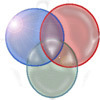
One or Both

Problem 1 was solved by 70% of the pupils. Problem 2 was solved by 60% of them. Can you work out how many pupils took the exam?
Age 14 to 16
ShortChallenge Level Yellow starYellow star
Problem Primary curriculum Secondary curriculum

Inclusion Exclusion

How many integers between 1 and 1200 are NOT multiples of any of the numbers 2, 3 or 5?

Age 11 to 14
Challenge Level Yellow starYellow starYellow star

  • Tech help
  • Accessibility Statement
  • Sign up to our newsletter
  • Twitter X logo

The NRICH Project aims to enrich the mathematical experiences of all learners. To support this aim, members of the NRICH team work in a wide range of capacities, including providing professional development for teachers wishing to embed rich mathematical tasks into everyday classroom practice.

NRICH is part of the family of activities in the Millennium Mathematics Project.

University of Cambridge logo NRICH logo