Skip over navigation


Try it a few times. What do you notice?
Can you prove it will always happen?
Choose a number in the $5$ times table.
Take the numbers on either side of your chosen number and find the difference between their squares.
Try it a few times. What do you notice?
Can you prove it will always happen?
Is there a similar relationship for other times tables?
Extension
Instead of taking the numbers on either side of your starting number, investigate what happens if you take the numbers two above and two below your starting number and then work out the difference between their squares...
If you enjoyed this problem you may like to try Why 24? next.
With thanks to Don Steward, whose ideas formed the basis of this problem.
Difference of Two Squares
Age 14 to 16
Challenge Level 

Difference of Two Squares printable worksheet
You may wish to look at the problem What's Possible? before trying this one.
Choose a number in the $3$ times table.Take the numbers on either side of your chosen number and find the difference between their squares.

Try it a few times. What do you notice?
Can you prove it will always happen?
Choose a number in the $5$ times table.
Take the numbers on either side of your chosen number and find the difference between their squares.
Try it a few times. What do you notice?
Can you prove it will always happen?
Is there a similar relationship for other times tables?
Extension
Instead of taking the numbers on either side of your starting number, investigate what happens if you take the numbers two above and two below your starting number and then work out the difference between their squares...
If you enjoyed this problem you may like to try Why 24? next.
With thanks to Don Steward, whose ideas formed the basis of this problem.
You may also like

DOTS Division
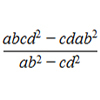
Take any pair of two digit numbers x=ab and y=cd where, without loss of generality, ab > cd . Form two 4 digit numbers r=abcd and s=cdab and calculate: {r^2 - s^2} /{x^2 - y^2}.
Sixational
The nth term of a sequence is given by the formula n^3 + 11n. Find the first four terms of the sequence given by this formula and the first term of the sequence which is bigger than one million. Prove that all terms of the sequence are divisible by 6.