Skip over navigation


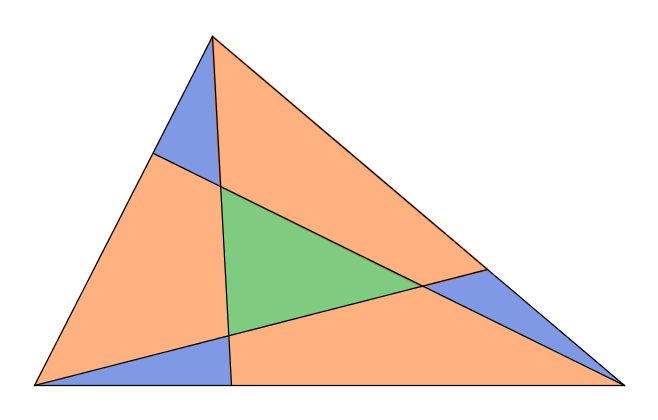
What fraction of the area of the whole triangle is the area of the green triangle?
If you are not sure how to get started, click below to read some thoughts, hints and suggestions that might be helpful. Before moving onto the next hint, do as much as you can with the information you have already worked out.
The base of triangle $a+f+e$ is $\tfrac{1}{3}$ of the base of the whole triangle.
Can you use this to work out the area of $a+f+e$ as a fraction of the whole triangle?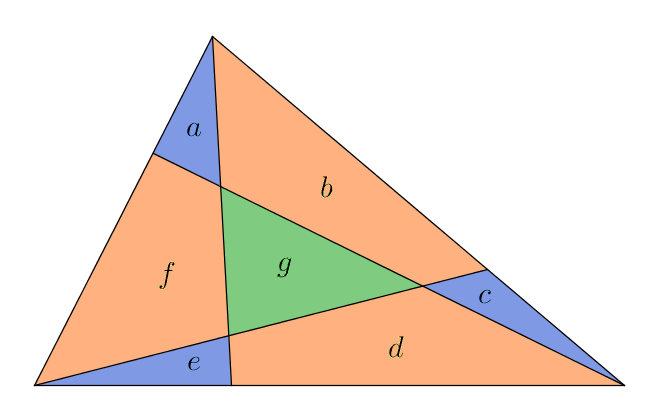
What about $a+b+c$ and $c+d+e$?
An alternative method for solving this problem is to use vectors.
Take a look at the Getting Started section if you want to think about this approach.
Can you find other interesting relationships in the diagram?
Can you prove that these relationships always hold?
With thanks to Dietmar Küchemann, whose ideas formed the basis of this problem.
Another Triangle in a Triangle
Age 16 to 18
Challenge Level 

You may wish to look at Triangle in a Triangle and Areas and Ratios before exploring this problem.
In the diagram below, points have been chosen that are one third of the way along each side. Each of these points is then joined to the opposite vertex.
In the diagram below, points have been chosen that are one third of the way along each side. Each of these points is then joined to the opposite vertex.
What fraction of the area of the whole triangle is the area of the green triangle?
If you are not sure how to get started, click below to read some thoughts, hints and suggestions that might be helpful. Before moving onto the next hint, do as much as you can with the information you have already worked out.
The base of triangle $a+f+e$ is $\tfrac{1}{3}$ of the base of the whole triangle.
Can you use this to work out the area of $a+f+e$ as a fraction of the whole triangle?
What about $a+b+c$ and $c+d+e$?
We have three triangles, each with an area of $\tfrac{1}{3}$ of the whole triangle.
But none of these tell us anything about $g$.
But we do know that $a$, $b$, $c$, $d$, $e$, $f$ and $g$ together make the whole triangle!
Can we combine all this to find an expression for $g$ in terms of other areas?
But none of these tell us anything about $g$.
But we do know that $a$, $b$, $c$, $d$, $e$, $f$ and $g$ together make the whole triangle!
Can we combine all this to find an expression for $g$ in terms of other areas?
It would be useful to know the areas of the little blue triangles...
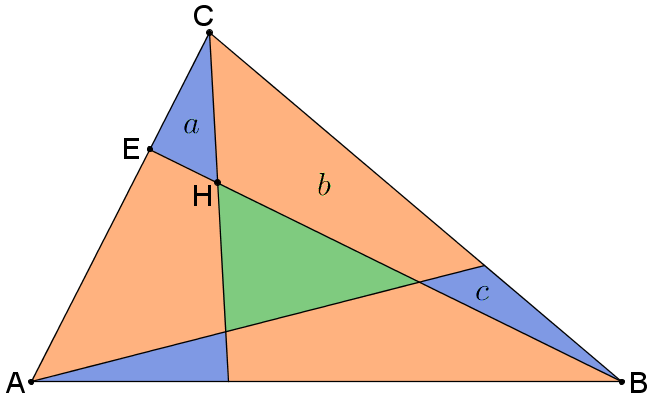 We know that:
If we can find the length $EH$ as a fraction of $HB$, we could work out the area of the blue triangle...
We know that:
- $a$ has the same height as triangle $ECB$.
- Triangle $ECB$ is $\tfrac{1}{3}$ of the whole triangle
If we can find the length $EH$ as a fraction of $HB$, we could work out the area of the blue triangle...
Sometimes it helps to add in an extra line...
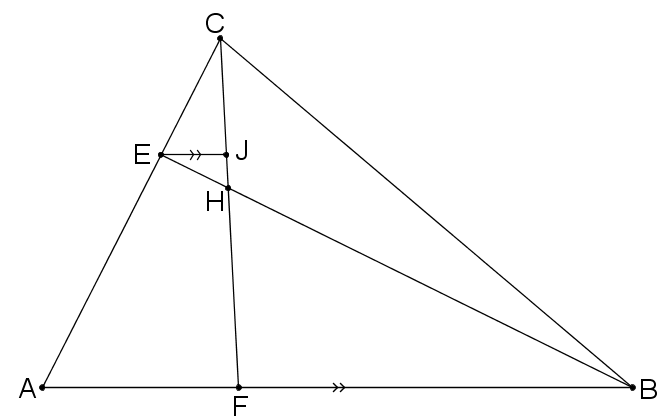
Can you find some similar triangles in this diagram?
How does $EJ$ compare with $AF$?
How does $EJ$ compare with $BF$
How does $EH$ compare with $HB$?
How does $EH$ compare with $EB$?
Can you find some similar triangles in this diagram?
How does $EJ$ compare with $AF$?
How does $EJ$ compare with $BF$
How does $EH$ compare with $HB$?
How does $EH$ compare with $EB$?
An alternative method for solving this problem is to use vectors.
Take a look at the Getting Started section if you want to think about this approach.
Extension
Can you find other interesting relationships in the diagram?
Can you prove that these relationships always hold?
With thanks to Dietmar Küchemann, whose ideas formed the basis of this problem.
You may also like
Napoleon's Hat
Three equilateral triangles ABC, AYX and XZB are drawn with the point X a moveable point on AB. The points P, Q and R are the centres of the three triangles. What can you say about triangle PQR?
Plane to See
P is the midpoint of an edge of a cube and Q divides another edge in the ratio 1 to 4. Find the ratio of the volumes of the two pieces of the cube cut by a plane through PQ and a vertex.