Skip over navigation


Herschel from the European School of Varese sent us this solution:
The first flower has 3 petals corresponding to the 3 corners of the triangle. The completed animation shows that each petal is a semicircle, so the perimeter of the flower is $3\times \pi \times \text{ radius } = 3 \times \pi \times \text{ (side of triangle) }= 3\pi r$.
The second flower has 4 petals. This time, each petal is a sector of a circle rather than a simple semicircle. The angle of this sector is 360 - (2 triangle corners) - (1 square corner) = $360 - 2 \times 60 - 90 = 150^\circ$.
Therefore, the total perimeter of this petal is $4 \times \frac{150}{360}\times (2\times \pi \times \text{ radius }) =\frac{10}{3} \times \pi \times \text{ (side of the square) }= \frac{10}{3} \pi r$.
In general, we need to know 3 key bits of data to work out the perimeter of the flower.
They are:
Triangles and Petals
Age 14 to 16
Challenge Level 

Herschel from the European School of Varese sent us this solution:
The first flower has 3 petals corresponding to the 3 corners of the triangle. The completed animation shows that each petal is a semicircle, so the perimeter of the flower is $3\times \pi \times \text{ radius } = 3 \times \pi \times \text{ (side of triangle) }= 3\pi r$.
The second flower has 4 petals. This time, each petal is a sector of a circle rather than a simple semicircle. The angle of this sector is 360 - (2 triangle corners) - (1 square corner) = $360 - 2 \times 60 - 90 = 150^\circ$.
Therefore, the total perimeter of this petal is $4 \times \frac{150}{360}\times (2\times \pi \times \text{ radius }) =\frac{10}{3} \times \pi \times \text{ (side of the square) }= \frac{10}{3} \pi r$.
In general, we need to know 3 key bits of data to work out the perimeter of the flower.
They are:
- The number of sides of the central shape; we'll call this $n$.
- The length of each side in the central shape; we'll call this $r$. (Note that this is equal to the radius of the petals).
- The angle at the centre of each petal. This can be derived from $n$:
$\text{Angle } = 360 - 2 \times 60 - \text{( Corner of shape)}$
$\text{Angle } = 360 - 120 - \frac{180(n-2)}{n}$
$\text{Angle } = 240 - 180 - \frac{360}{n}$
$\text{Angle } = 60 + \frac{360}{n}$
Given these data, we can proceed to work out a general formula:
Perimeter= (number of petals) $\times$ (perimeter of a full circle) $\times \frac{\text{angle at centre of petal}}{360}$
$\text{Perimeter }= n \times 2 \times \pi \times r \times \frac{(60+ \frac{360}{n})}{360}$
$\text{Perimeter }= 2 \times \pi \times n \times r \times (\frac{1}{6}+\frac{1}{n})$
$\text{Perimeter }= 2 \times \pi \times n \times r \times \frac{6+n}{6n}$
$\text{Perimeter }= \pi \times r \times \frac{6+n}{3}$
Using this formula, we find the following results:
$n=3$ (Triangle): Perimeter = $\pi \times r \times \frac{9}{3} = 3 \pi r$
$n=4$ (Square): Perimeter = $\pi \times r \times \frac{10}{3}$
$n=5$ (Pentagon): Perimeter = $\pi \times r \times \frac{11}{3}$
$n=6$ (Hexagon): Perimeter = $\pi \times r \times \frac{12}{3} = 4\pi r$
$n=7$ (Heptagon): Perimeter = $\pi \times r \times \frac{13}{3}$
$n=8$ (Octagon): Perimeter = $\pi \times r \times \frac{14}{3}$
...
$n=100$: Perimeter = $\pi \times r \times \frac{106}{3}$
So a shape with 100 sides will produce a flower with a perimeter of $\pi \times r \times \frac{106}{3}$.
If each edge of the central shape has a length of 1, the perimeter of the flower will be $35.333 \times \pi$, which is 111.00 to two decimal places.
Well done to Saif from Havering Sixth Form College, Nina, Jure and Kristjan from Elementary school Loka Crnomelj, Slovenia, Chi from Raynes Park, Rajeev from Haberdashers' Aske's Boys' School, Yun Seok Kang, and Cameron, who also sent in correct solutions. Click here to read Nina, Jure and Kristjan's thoughts.
You may also like
Giant Holly Leaf
Find the perimeter and area of a holly leaf that will not lie flat (it has negative curvature with 'circles' having circumference greater than 2πr).
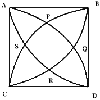
Quadarc
Given a square ABCD of sides 10 cm, and using the corners as centres, construct four quadrants with radius 10 cm each inside the square. The four arcs intersect at P, Q, R and S. Find the area enclosed by PQRS.
Get Cross
A white cross is placed symmetrically in a red disc with the central square of side length sqrt 2 and the arms of the cross of length 1 unit. What is the area of the disc still showing?