Skip over navigation
Cambridge University Faculty of Mathematics NRich logo
menu search
  • Teachers expand_more
    • Early years
    • Primary
    • Secondary
    • Post-16
    • Events
    • Professional development
  • Students expand_more
    • Primary
    • Secondary
    • Post-16
  • Parents expand_more
    • Early Years
    • Primary
    • Secondary
    • Post-16
  • Problem-Solving Schools
  • About NRICH expand_more
    • About us
    • Impact stories
    • Support us
    • Our funders
    • Contact us
  • search

Or search by topic

Number and algebra

  • The Number System and Place Value
  • Calculations and Numerical Methods
  • Fractions, Decimals, Percentages, Ratio and Proportion
  • Properties of Numbers
  • Patterns, Sequences and Structure
  • Algebraic expressions, equations and formulae
  • Coordinates, Functions and Graphs

Geometry and measure

  • Angles, Polygons, and Geometrical Proof
  • 3D Geometry, Shape and Space
  • Measuring and calculating with units
  • Transformations and constructions
  • Pythagoras and Trigonometry
  • Vectors and Matrices

Probability and statistics

  • Handling, Processing and Representing Data
  • Probability

Working mathematically

  • Thinking mathematically
  • Developing positive attitudes
  • Cross-curricular contexts

Advanced mathematics

  • Decision Mathematics and Combinatorics
  • Advanced Probability and Statistics
  • Mechanics
  • Calculus

For younger learners

  • Early Years Foundation Stage

Cut Nets

Age 7 to 11
Challenge Level Yellow starYellow star
Primary curriculum
  • Problem
  • Getting Started
  • Student Solutions
  • Teachers' Resources

Cut Nets


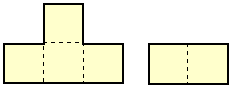
The net of a cube has been cut into two. It could be put together in several ways so that it could be folded into a cube.
 

cube net cut in half

Here are the nets of $9$ solid shapes. Each one of these has been cut into $2$ pieces, like the net of the cube.
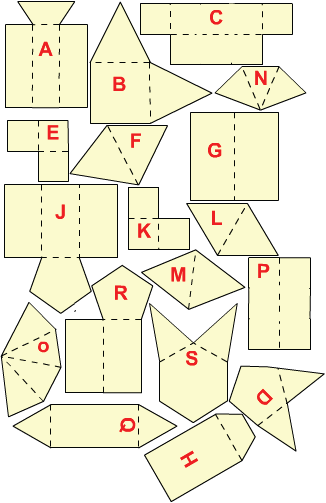
 

Can you see which pieces go together?


Why do this problem?

This problem makes children think hard about the nets of various polyhedra. It is not enough to know roughly what they look like. The number and shape of the faces and the way they are connected are important. It will help to develop children's visualisation skills and increase their familiarity with appropriate vocabulary. It provides an excellent opportunity for describing properties of 3D shapes.


Possible approach

You could start by talking about properties of some solid shapes with the group. One way to do this might be to hold up two shapes and ask them to talk about their similarities and differences. Depending on the children's experience you may need to explain what a net is, but they don't necessarily need to have worked extensively with nets in order to have a go at this problem.

You could introduce the problem on an interactive whiteboard or data projector but it would be helpful for children to have a copy of this sheet in pairs and to work together so that they are able to talk through their ideas with a partner. Scissors and sticky tape would be useful!

Some children will relish the challenge of discovering for themselves which shapes have been used but some may work better knowing which they were to find. The shapes are: a cube, cuboid, tetrahedron, square pyramid, pentagonal pyramid, hexagonal pyramid, triangular prism, pentagonal prism, trapezoid prism.

Key questions

How do you think these two pieces could fit together?
Which piece could go with this one?
What shape are the faces on a ...?

Possible extension

Learners could make some nets of these or other polyhedra and possibly cut them to make puzzles for a friend.


Possible support

You could start some children off with just three shapes using, for example, pieces $B$, $E$, $F$, $K$, $L$ and $M$.

You may also like

Tetrahedron Faces

One face of a regular tetrahedron is painted blue and each of the remaining faces are painted using one of the colours red, green or yellow. How many different possibilities are there?
Face Painting

You want to make each of the 5 Platonic solids and colour the faces so that, in every case, no two faces which meet along an edge have the same colour.
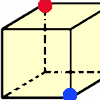
Redblue

Investigate the number of paths you can take from one vertex to another in these 3D shapes. Is it possible to take an odd number and an even number of paths to the same vertex?

  • Tech help
  • Accessibility Statement
  • Sign up to our newsletter
  • Twitter X logo

The NRICH Project aims to enrich the mathematical experiences of all learners. To support this aim, members of the NRICH team work in a wide range of capacities, including providing professional development for teachers wishing to embed rich mathematical tasks into everyday classroom practice.

NRICH is part of the family of activities in the Millennium Mathematics Project.

University of Cambridge logo NRICH logo