Skip over navigation


As the path of the ribbon around the box does not change direction when it reaches each edge, it can be drawn as a single straight line. As the ribbon crosses two faces of the box twice, a simple net of the box can show the path as a single straight line.
I therefore numbered the faces 1-6 and checked the order the ribbon went over them. This led to the diagram submitted, which I used to work out the length of the ribbon via Pythagoras' theorem.
The length of the ribbon is given by:
$$ \sqrt{(2 \times 5 + 2\times 10)^2 +(2 \times 5 + 2\times 20)^2}$$
By rearranging the above and substituting W, L and H for thelengths of the sides, the general expression for the length of the ribbon is therefore:
$$ 2\sqrt{(W+H)^2 + (L+H)^2}$$ or $$ 2\sqrt{W^2 + L^2 + 2H^2 + 2(WH + LH)} $$
where $H$ is the length of a shortest edge of a box, $W$ and $L$ the lengths of the longer sets of sides.
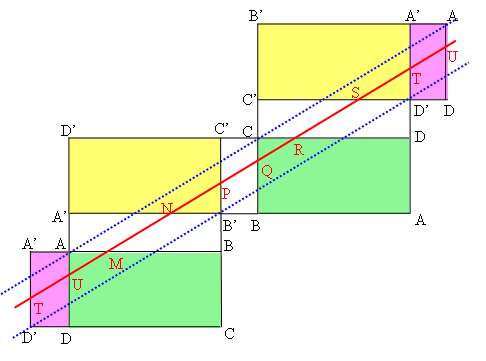
The condition of the problem is matched only when the red line passes through the same $U$, i.e. the dashed blue passes through the same $A$. So, the length of the ribbon is the distance $A$-$A$.
The blue dashed lines are the extreme positions of the ribbon, and between these positions the ribbon could glide. Each of these extreme positions has one of the two parallel lines reduced to a point.
All Tied Up
Age 14 to 16
Challenge Level 

A solution based on the one from Richard is given below. I was not able to use Richard's original diagram but hope the one submitted is sufficient:
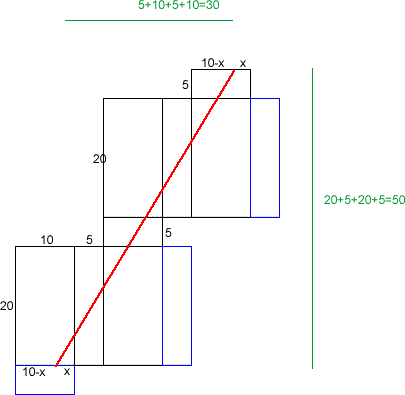
As the path of the ribbon around the box does not change direction when it reaches each edge, it can be drawn as a single straight line. As the ribbon crosses two faces of the box twice, a simple net of the box can show the path as a single straight line.
I therefore numbered the faces 1-6 and checked the order the ribbon went over them. This led to the diagram submitted, which I used to work out the length of the ribbon via Pythagoras' theorem.
The length of the ribbon is given by:
$$ \sqrt{(2 \times 5 + 2\times 10)^2 +(2 \times 5 + 2\times 20)^2}$$
By rearranging the above and substituting W, L and H for thelengths of the sides, the general expression for the length of the ribbon is therefore:
$$ 2\sqrt{(W+H)^2 + (L+H)^2}$$ or $$ 2\sqrt{W^2 + L^2 + 2H^2 + 2(WH + LH)} $$
where $H$ is the length of a shortest edge of a box, $W$ and $L$ the lengths of the longer sets of sides.
A little more from Andrei - many thanks:
The condition of the problem is matched only when the red line passes through the same $U$, i.e. the dashed blue passes through the same $A$. So, the length of the ribbon is the distance $A$-$A$.
The blue dashed lines are the extreme positions of the ribbon, and between these positions the ribbon could glide. Each of these extreme positions has one of the two parallel lines reduced to a point.
You may also like
Fitting In
The largest square which fits into a circle is ABCD and EFGH is a square with G and H on the line CD and E and F on the circumference of the circle. Show that AB = 5EF. Similarly the largest equilateral triangle which fits into a circle is LMN and PQR is an equilateral triangle with P and Q on the line LM and R on the circumference of the circle. Show that LM = 3PQ
Triangle Midpoints
You are only given the three midpoints of the sides of a triangle. How can you construct the original triangle?