Skip over navigation


Sue Liu of Madras College, St Andrews sent an excellent solution to this question.
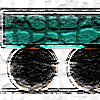
Suppose that $a$ is the radius of the axle, $b$ is the radius of each ball-bearing, and $c$ is the radius of the hub (see the figure).
The solution is based on the following figure.

The angle subtended by each ball-bearing at the centre of the axle is $2\pi/n$, so that in the triangle $OPQ$ we have $$OQ= a+b, \quad PQ = b, \quad \angle POQ = \pi/n$$ and hence
The same conclusion can be made if we know that in the general case the internal radius of the hub is an integer multiple of the radius of each ball-bearing.
Finally, as this same conclusion, namely $n=6$, can be drawn whenever one of the ratios $a/b$, $b/c$, $c/a$ are rational numbers and, as the case $n=6$ is not practical (many more ballbearings are needed) it follows that in all cases of, for example, bicycle wheels, these ratios are irrational. It therefore follows that it is impossible to manufacture a perfectly fitting set of ball-bearings.
Ball Bearings
Age 16 to 18
Challenge Level 

Sue Liu of Madras College, St Andrews sent an excellent solution to this question.
Suppose that $a$ is the radius of the axle, $b$ is the radius of each ball-bearing, and $c$ is the radius of the hub (see the figure).
The solution is based on the following figure.
The angle subtended by each ball-bearing at the centre of the axle is $2\pi/n$, so that in the triangle $OPQ$ we have $$OQ= a+b, \quad PQ = b, \quad \angle POQ = \pi/n$$ and hence
- $$(a+b)\sin (\pi/n) = b.$$
- $$c = OP' = OP +PP' = a+2b.$$
The same conclusion can be made if we know that in the general case the internal radius of the hub is an integer multiple of the radius of each ball-bearing.
Finally, as this same conclusion, namely $n=6$, can be drawn whenever one of the ratios $a/b$, $b/c$, $c/a$ are rational numbers and, as the case $n=6$ is not practical (many more ballbearings are needed) it follows that in all cases of, for example, bicycle wheels, these ratios are irrational. It therefore follows that it is impossible to manufacture a perfectly fitting set of ball-bearings.
You may also like
Overarch 2
Bricks are 20cm long and 10cm high. How high could an arch be built without mortar on a flat horizontal surface, to overhang by 1 metre? How big an overhang is it possible to make like this?
Cushion Ball
The shortest path between any two points on a snooker table is the straight line between them but what if the ball must bounce off one wall, or 2 walls, or 3 walls?
Stonehenge
Explain why, when moving heavy objects on rollers, the object moves twice as fast as the rollers. Try a similar experiment yourself.