Skip over navigation


How many major thirds are there in an octave on a musical scale?
Going back in history, before the discovery of logarithms, some theorists used Euclid's algorithm to find the answer to this question.
A rational approximation ${m\over n}$ for the relationship between 5/4, the musical interval called the major third, and the octave 2/1, is given by $$ \left({5\over 4}\right)^m \approx \left({2\over 1}\right)^n, $$ where $m$ and $n$ are integers. Using Euclid's algorithm show that ${m\over n}={28\over 9}$ gives a first approximation and find three closer rational approximations.
Euclid's Algorithm and Musical Intervals
Age 16 to 18
Challenge Level 

How many major thirds are there in an octave on a musical scale?
Going back in history, before the discovery of logarithms, some theorists used Euclid's algorithm to find the answer to this question.
A rational approximation ${m\over n}$ for the relationship between 5/4, the musical interval called the major third, and the octave 2/1, is given by $$ \left({5\over 4}\right)^m \approx \left({2\over 1}\right)^n, $$ where $m$ and $n$ are integers. Using Euclid's algorithm show that ${m\over n}={28\over 9}$ gives a first approximation and find three closer rational approximations.
In the articles
Euclid's Algorithm and
Approximations, Euclid's Algorithm and Continued Fractions you
can find out about this method and also that Euclid's algorithm can
be used not only for integers but for any numbers.
[See also the problems
Tuning and Ratio and
Rarity. The set of three problems on mathematics and music was
devised by Benjamin Wardaugh who used to be a member of the NRICH
team. Benjamin is now doing research into the history of
mathematics and music at Oxford University and his article Music
and Euclid's Algorithm should help you with this
problem.]
You may also like
Good Approximations
Solve quadratic equations and use continued fractions to find rational approximations to irrational numbers.
There's a Limit
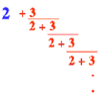
Explore the continued fraction: 2+3/(2+3/(2+3/2+...)) What do you notice when successive terms are taken? What happens to the terms if the fraction goes on indefinitely?
Not Continued Fractions
Which rational numbers cannot be written in the form x + 1/(y + 1/z) where x, y and z are integers?