Skip over navigation


Euclid's algorithm can be used not only for integers but for any two numbers.
You could use the same method for this problem as given in the article Approximations, Euclid's Algorithm and Continued Fractions for finding rational approximations to $\pi$. In this method you write the process down in terms of continued fractions.
Alternatively, see the article by Benjamin Wardhaugh in the Plus magazine entitled Euclid's Algorithm and Music which shows a method for solving this problem. The examples given there use different numbers. If you use this method it might be easier if you write down your working using the factorizations of the numbers involved, rather than writing them out in full.
Euclid's Algorithm and Musical Intervals
Age 16 to 18
Challenge Level 

Euclid's algorithm can be used not only for integers but for any two numbers.
You could use the same method for this problem as given in the article Approximations, Euclid's Algorithm and Continued Fractions for finding rational approximations to $\pi$. In this method you write the process down in terms of continued fractions.
Alternatively, see the article by Benjamin Wardhaugh in the Plus magazine entitled Euclid's Algorithm and Music which shows a method for solving this problem. The examples given there use different numbers. If you use this method it might be easier if you write down your working using the factorizations of the numbers involved, rather than writing them out in full.
You may also like
Good Approximations
Solve quadratic equations and use continued fractions to find rational approximations to irrational numbers.
There's a Limit
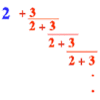
Explore the continued fraction: 2+3/(2+3/(2+3/2+...)) What do you notice when successive terms are taken? What happens to the terms if the fraction goes on indefinitely?
Not Continued Fractions
Which rational numbers cannot be written in the form x + 1/(y + 1/z) where x, y and z are integers?