Skip over navigation


$$ \left({5\over 4}\right)^m = \left({2\over 1}\right)^n .$$ This can be written equivalently: $$m\log {5\over 4} = n \log 2$$ or $${m\over n} = {\log 2 \over \log 5 - log 4} = 3.10628372 \quad (1).$$ Now, I shall use Euclid's algorithm to find the first 4 rational approximations of: $${\log 2 \over \log 5 - log 4}.$$ For the first approximation, I write: $$3.10628372 = 3 + {1\over {1\over 0.10628372}} \approx 3 + {1\over 9.408778692}\quad (2).$$ So, the first approximation is $${m\over n} \approx 3 + {1\over 9} = {28\over 9} = 3.111111111....$$ Now, for the second approximation I have: $$3 + {1 \over \displaystyle 9 + {1\over \displaystyle {1\over \displaystyle 0.408778692}}} = 3 + {1 \over \displaystyle 9 + {1\over \displaystyle 2.446311463}}$$ The second approximation for $m/n$ is: $${m\over n} \approx 3 + {1\over {9 + {1 \over \displaystyle 2}}} = {59\over 19} \approx 3.105263158.$$ For the third approximation, I obtain: $$3 + {1 \over \displaystyle 9 + {1\over \displaystyle 2 + {1\over \displaystyle {1\over \displaystyle 0.446311463}}}} = 3 + {1 \over \displaystyle 9 + {1\over \displaystyle 2 + {1\over \displaystyle 2.240587757}}}.$$ and consequently $${m\over n} \approx 3 + {1\over \displaystyle 9 + {1\over \displaystyle 2 + {1\over \displaystyle 2}}} = 3 + {1\over \displaystyle 9 + {2\over \displaystyle 5}}= {146\over 47} \approx 3.106382979.$$ Then the fourth approximation for m/n is: $${m\over n} \approx 3 + {1 \over \displaystyle 9 + {1\over \displaystyle 2 + {1\over \displaystyle 2 + {1\over \displaystyle 4}}}} = {643\over 207} \approx 3.106280193.$$ I see that using continued fractions I come nearer to the given real number by rational numbers greater and smaller than the number: the first and third approximations are greater than $m/n$ and the second and the fourth are smaller than the initial number.
This is a natural thing. I arrived to the first approximation considering, in relation (2) a smaller denominator: $${m\over n}\approx 3 + {1\over 9.408778692} < 3 + {1\over 9} = {28\over 9}.$$ Now, I shall do the same thing for the second approximation: $${m\over n} \approx 3 + {1\over 9 + {1\over \displaystyle 2.446311463}} > 3 + {1\over 9 + {1\over \displaystyle 2}}.$$ So, the second approximation is smaller than the initial number.
In a similar manner, the odd-order approximations are greater than $m/n$, but they form a decreasing series. The even-order approximations are smaller than $m/n$, and they form an increasing series.
Euclid's Algorithm and Musical Intervals
Age 16 to 18
Challenge Level 

Here is another beautifully explained solution from Andrei of Tudor Vianu National College, Bucharest, Romania:
$$ \left({5\over 4}\right)^m = \left({2\over 1}\right)^n .$$ This can be written equivalently: $$m\log {5\over 4} = n \log 2$$ or $${m\over n} = {\log 2 \over \log 5 - log 4} = 3.10628372 \quad (1).$$ Now, I shall use Euclid's algorithm to find the first 4 rational approximations of: $${\log 2 \over \log 5 - log 4}.$$ For the first approximation, I write: $$3.10628372 = 3 + {1\over {1\over 0.10628372}} \approx 3 + {1\over 9.408778692}\quad (2).$$ So, the first approximation is $${m\over n} \approx 3 + {1\over 9} = {28\over 9} = 3.111111111....$$ Now, for the second approximation I have: $$3 + {1 \over \displaystyle 9 + {1\over \displaystyle {1\over \displaystyle 0.408778692}}} = 3 + {1 \over \displaystyle 9 + {1\over \displaystyle 2.446311463}}$$ The second approximation for $m/n$ is: $${m\over n} \approx 3 + {1\over {9 + {1 \over \displaystyle 2}}} = {59\over 19} \approx 3.105263158.$$ For the third approximation, I obtain: $$3 + {1 \over \displaystyle 9 + {1\over \displaystyle 2 + {1\over \displaystyle {1\over \displaystyle 0.446311463}}}} = 3 + {1 \over \displaystyle 9 + {1\over \displaystyle 2 + {1\over \displaystyle 2.240587757}}}.$$ and consequently $${m\over n} \approx 3 + {1\over \displaystyle 9 + {1\over \displaystyle 2 + {1\over \displaystyle 2}}} = 3 + {1\over \displaystyle 9 + {2\over \displaystyle 5}}= {146\over 47} \approx 3.106382979.$$ Then the fourth approximation for m/n is: $${m\over n} \approx 3 + {1 \over \displaystyle 9 + {1\over \displaystyle 2 + {1\over \displaystyle 2 + {1\over \displaystyle 4}}}} = {643\over 207} \approx 3.106280193.$$ I see that using continued fractions I come nearer to the given real number by rational numbers greater and smaller than the number: the first and third approximations are greater than $m/n$ and the second and the fourth are smaller than the initial number.
This is a natural thing. I arrived to the first approximation considering, in relation (2) a smaller denominator: $${m\over n}\approx 3 + {1\over 9.408778692} < 3 + {1\over 9} = {28\over 9}.$$ Now, I shall do the same thing for the second approximation: $${m\over n} \approx 3 + {1\over 9 + {1\over \displaystyle 2.446311463}} > 3 + {1\over 9 + {1\over \displaystyle 2}}.$$ So, the second approximation is smaller than the initial number.
In a similar manner, the odd-order approximations are greater than $m/n$, but they form a decreasing series. The even-order approximations are smaller than $m/n$, and they form an increasing series.
You may also like
Good Approximations
Solve quadratic equations and use continued fractions to find rational approximations to irrational numbers.
There's a Limit
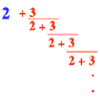
Explore the continued fraction: 2+3/(2+3/(2+3/2+...)) What do you notice when successive terms are taken? What happens to the terms if the fraction goes on indefinitely?
Not Continued Fractions
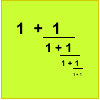
Which rational numbers cannot be written in the form x + 1/(y + 1/z) where x, y and z are integers?