Skip over navigation


Visualisation of 3D objects is a very useful real-life skill used in a range of everyday situations, from packing suitcases and boxes into the back of a car to travel to university through to parking the car in a tight space upon arrival. We can practise and develop our 3D skills and intuition through the study of the following sorts of mathematical problems. Spatial problems are mathematically quite different to algebraic problems and you may find one type of problem easier or more difficult depending on how your brain works!
I have some cubes of cheese and cut them into pieces using straight cuts from a very sharp cheese wire. In between cuts I do not move the pieces from the original cube shape.
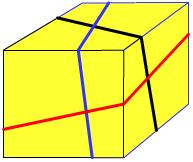
For example, with just one cut I will obviously get two smaller pieces of cheese, with two cuts I can get up to 4 pieces of cheese and with three cuts I can get up to $8$ pieces of cheese, as shown in the picture:


Cheese Cutting
Age 16 to 18
Challenge Level 
Visualisation of 3D objects is a very useful real-life skill used in a range of everyday situations, from packing suitcases and boxes into the back of a car to travel to university through to parking the car in a tight space upon arrival. We can practise and develop our 3D skills and intuition through the study of the following sorts of mathematical problems. Spatial problems are mathematically quite different to algebraic problems and you may find one type of problem easier or more difficult depending on how your brain works!
I have some cubes of cheese and cut them into pieces using straight cuts from a very sharp cheese wire. In between cuts I do not move the pieces from the original cube shape.
For example, with just one cut I will obviously get two smaller pieces of cheese, with two cuts I can get up to 4 pieces of cheese and with three cuts I can get up to $8$ pieces of cheese, as shown in the picture:
Suppose I now make a fourth cut. How many individual pieces of
cheese can I make?
Suppose now that I am allowed more generally to cut the block
$N$ times. Can you say anything about the maximum or minimum number
of pieces of chesse that you will be able to create?
Although you will not be able to determine the theoretical
maximum number of pieces of cheese for $N$ cuts, you can always
create a systematic cutting system which will generate a
pre-detemined number of pieces (for example, making $N$ parallel
cuts will always result in $N+1$ pieces of cheese). Investigate
developing better cutting algorithms which will provide larger
numbers of pieces. Using your algorithm what is the largest number
of pieces of cheese you can make for $10$, $50$ and $100$
cuts?
You may also like
Circles Ad Infinitum
A circle is inscribed in an equilateral triangle. Smaller circles touch it and the sides of the triangle, the process continuing indefinitely. What is the sum of the areas of all the circles?
Set Square
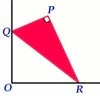
A triangle PQR, right angled at P, slides on a horizontal floor with Q and R in contact with perpendicular walls. What is the locus of P?
Wrapping Gifts
A box of size a cm by b cm by c cm is to be wrapped with a square piece of wrapping paper. Without cutting the paper what is the smallest square this can be?