Skip over navigation


It is important to realise in this question that the cross is not like a normal Mendelian cross, but that all previously accumulated genetic infortmation is inherited.
It would be impossible to create an offspring who was two-thirds G and one-third M. This can be explained as follows: each successive generation doubles the number of possible 'parts' that it can be made out of. For example the first generation is purely G or M, whereas the second generation has two 'parts' - it can be GG, MM or GM. Additionally, the third generation has four parts and can be GGGG, GGGM, GGMM, GMMM or MMMM. Thus, the number of 'parts' is clearly $2^n$ where n is an integer.
In order to be able to be composed on one-third M, we are essentially asking if there is a value of n such that $\frac{2^n}{3}$ is an integer. It can be seen that there is no value of n to make this true because $2^n$ generates numbers which are divisible only by the prime number 2, but by no other primes. Because 3 is a prime number, this means that the expression can never yield an integer.
We are looking to find a composition which is within 1% of $\frac{1}{3}$. which is equivalent to the range $\frac{99}{300}$ - $\frac{101}{300}$ which is $0.33 - 0.33\dot{6}$.
Using trial and error:
$\frac{3}{8} = 0.375$
$\frac{5}{16} = 0.313$
$\frac{11}{32} = 0.348$
$\frac{21}{64} = 0.328$
$\mathbf{\frac{43}{128} = 0.3359}$
Thus, 128 = 2$^7$, and so there need to be a minimum of 8 generations. Can you draw out the crossing scheme to create this final progeny?
The Genes of Gilgamesh
Age 14 to 16
Challenge Level 

It is important to realise in this question that the cross is not like a normal Mendelian cross, but that all previously accumulated genetic infortmation is inherited.
It would be impossible to create an offspring who was two-thirds G and one-third M. This can be explained as follows: each successive generation doubles the number of possible 'parts' that it can be made out of. For example the first generation is purely G or M, whereas the second generation has two 'parts' - it can be GG, MM or GM. Additionally, the third generation has four parts and can be GGGG, GGGM, GGMM, GMMM or MMMM. Thus, the number of 'parts' is clearly $2^n$ where n is an integer.
In order to be able to be composed on one-third M, we are essentially asking if there is a value of n such that $\frac{2^n}{3}$ is an integer. It can be seen that there is no value of n to make this true because $2^n$ generates numbers which are divisible only by the prime number 2, but by no other primes. Because 3 is a prime number, this means that the expression can never yield an integer.
We are looking to find a composition which is within 1% of $\frac{1}{3}$. which is equivalent to the range $\frac{99}{300}$ - $\frac{101}{300}$ which is $0.33 - 0.33\dot{6}$.
Using trial and error:
$\frac{3}{8} = 0.375$
$\frac{5}{16} = 0.313$
$\frac{11}{32} = 0.348$
$\frac{21}{64} = 0.328$
$\mathbf{\frac{43}{128} = 0.3359}$
Thus, 128 = 2$^7$, and so there need to be a minimum of 8 generations. Can you draw out the crossing scheme to create this final progeny?
You may also like
There's a Limit
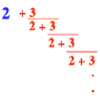
Explore the continued fraction: 2+3/(2+3/(2+3/2+...)) What do you notice when successive terms are taken? What happens to the terms if the fraction goes on indefinitely?
Not Continued Fractions
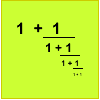
Which rational numbers cannot be written in the form x + 1/(y + 1/z) where x, y and z are integers?