Skip over navigation


What possible effects could very large doses of certain drugs administered weekly to attain the same minimum drug level as a daily dose have on a patient?
What if a drug breaks down into another physiologically active compound? How would this impact on the level of drug derived active compounds if a daily dose is given?
Can you think of any other scenarios where similar patterns of decay are observed?


Drug Stabiliser
Age 16 to 18
Challenge Level 
Why do this problem?
This problem gives an interesting insight into basics of drug administration and consider how altering the dosage given affects the levels of a drug in the body. It gives a good application of the concept of exponential decay in a way that does not need to be algebraic but gives a greater appreciation of the nature of these formulae in numerical terms.Possible approach
This problem would work well as a homework exercise followed up by a class discussion of the problem. The concepts required are not complex but may involve some in depth reasoning. It might be a good idea to ask students to explain their reasoning and discuss some of the latter problems in class if they prove too tricky.Key questions
- How does the level of a drug in the body vary depending on its half-life?
- How does the question of when the drug is administered affect the minimum and maximum levels of the drug in the body?
- Can you represent your thoughts in an algebraic form that makes calculations easier?
Possible extension
Can students plot the relationships that they find in
graphical form?
What possible effects could very large doses of certain drugs administered weekly to attain the same minimum drug level as a daily dose have on a patient?
What if a drug breaks down into another physiologically active compound? How would this impact on the level of drug derived active compounds if a daily dose is given?
Can you think of any other scenarios where similar patterns of decay are observed?
Possible support
The worked solution should offer a great degree of support. Some background information on the mathematics of exponential decay would be useful in completing this problem. Graphs of decay relationships may help conceptual understanding.You may also like
Big, Bigger, Biggest
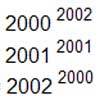
Which is the biggest and which the smallest of $2000^{2002}, 2001^{2001} \text{and } 2002^{2000}$?
Infinite Continued Fractions
In this article we are going to look at infinite continued fractions - continued fractions that do not terminate.
Gosh Cosh
Explore the hyperbolic functions sinh and cosh using what you know about the exponential function.