Skip over navigation



Building Gnomons
Age 14 to 16
Challenge Level 

Why do this problem?
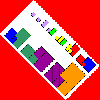
This problem is about investigating a numerical sequence using pictorial representations. Learners investigate the reflections and rotations needed to combine two consecutive pictures in the sequence to make the next, thus gaining a deeper understanding of the structure of the Fibonacci numbers. Learners may describe patterns in the sequence using their own symbolic representations.Possible approach
Write up the sequence $1, 1, 2, 3, 5$ on the board. Ask for
suggestions as to what might come next, with reasons why. Reveal
that the sequence we are investigating is the Fibonacci sequence
made by adding together the previous two terms of the sequence
(starting with 0,1).
Show the picture of the gnomons and allow the class some time
to experiment until they can find ways of transforming two
consecutive gnomons into the next one. It is important to have some
sense of the orientation of the gnomon - the diagrams in the
problem all have the missing part of the rectangle in the top left,
so this convention could be adopted. The idea is to come up with a
set of instructions which describes how to manipulate
two consecutive gnomons to make the next gnomon in the sequence.
Learners may adopt shorthand ways of writing any reflections and
rotations they have used, but it is important that they are
accurate in their recording in order to spot (and later justify)
patterns. One way of checking the accuracy of their recording is
for everyone to swap their instructions with someone else to see if
they make sense when followed to the letter.
The second part of the problem starts to look at the lengths
of the sides of the gnomons and investigate the Fibonacci sequence.
The key is to come up with a systematic way of recording the edges
in terms of the Fibonacci numbers; there is a diagram in the Hint
which may help.
Key questions
Can you describe how
you have joined your gnomons to make the next one in the sequence
in a way that other people can understand?
Is there more than one way of joining gnomons?
Can you generate all the gnomons using the same process each
time?
Possible extension
Gnomon
Dimensions looks at more patterns and generalisations that can
be made.
Possible support
Cutting out and physically manipulating the gnomons or making gnomons from cubes can help learners to describe patterns that emerge.You may also like
Gnomon Dimensions
These gnomons appear to have more than a passing connection with the Fibonacci sequence. This problem ask you to investigate some of these connections.

Searching for Mean(ing)
If you have a large supply of 3kg and 8kg weights, how many of each would you need for the average (mean) of the weights to be 6kg?