Skip over navigation


Yana sent in the following ideas about this problem:
In order to make gnomon twelve, the tenth gnomon would have to be reflected and the eleventh gnomon rotated 90 degrees anticlockwise. This is due to a pattern that can be seen after trying to fit together a few of the smaller gnomons.
In the first pair, when you use gnomons with areas 3 and 5 to make a gnomon with area 8, the gnomon with the smaller area is rotated and the one with the larger area is reflected. In the next pair it is the other way round and in the pair of gnomons after that, the smaller one is rotated and the other one reflected again and so on.
You can use Fibonacci numbers to work out perimeters of larger gnomons. First, you can make a table of the lengths (in terms of Fibonacci numbers, i.e. $F_1=1, F_2=1, F_3=2, F_4=3,$ etc.) of the different sides of gnomons, starting from the gnomon with the area of 3, to see if there is a pattern.
1) $2F_1, 2F_2, 2F_3$
2) $F_1, 2F_2, 2F_3, F_4$
3) $2F_2, 2F_3, 2F_4$
4) $F_2, 2F_3, 2F_4, F_5$
5) $2F_3, 2F_4, 2F_5$
6) $F_3, 2F_4, 2F_5, F_6$
7) $2F_4, 2F_5, 2F_6$
Two different patterns emerge. There is one pattern for gnomons with an odd index number and another for gnomons with an even index number. These patterns can be expressed in terms of $F_n$ and $F_m$ on diagrams to show what happens more generally and how the lengths of certain sides change (where $n$ stands for the number of the gnomon in the sequence of those with an odd index number and $m$ is the number of the gnomon in the sequence of those with an even index number).
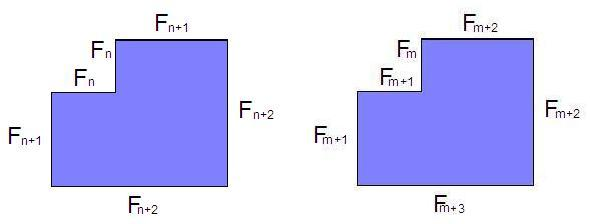
Excellent thinking, Yana!
Rosie from Edinburgh finished off Yana's thinking.
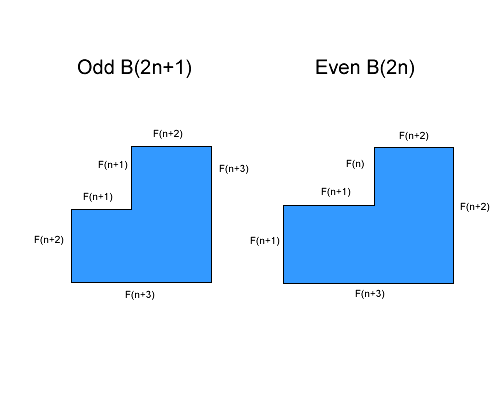
So now we can see really clearly where they will fit together. If we are making an even gnomon, say 12, then we can use as above. $n$ becomes 5, and we can see if the even block is reflected in a vertical axis, and then the odd block rotated $90^\circ$ anitclockwise then they will fit together, as $2n, 2n+1$ are consecutive numbers. To make an odd number block we want $2n-1$ rather than $2n+1$, as we want the consecutive numbers $2n-1, 2n$. Replace $n$ with $n-1$ throughout the diagram, and it will still work. Then as above the smaller block is reflected, and then the larger block is rotated and then they are joined.
From these we can see the edges will always be fibonacci numbers. If you combine the blocks together, you get all edges as a sum of two consecutive fibonacci numbers ($F_{n+3}+F_{n+2}=F_{n+4}$ in the above).
Perimeters:
In the odd example, the perimeter is
$P_O=2\times (F_{n+1}+F_{n+2}+F_{n+3})$
$P_O=4\times F_{n+3}$
as $F_{n+1}+F_{n+2}=F_{n+3}$
In the even example, the perimeter is
$P_E=F_n+F_{n+3}+2\times (F_{n+1}+F_{n+2})$
$P_E=2\times F_{n+4}$
as $(F_n+F_{n+1})+(F_{n+1}+F_{n+2})=F_{n+2}+F_{n+3}=F_{n+4}$
So now all we need to know is how to calculate the $n^{th}$ fibonacci number.
I looked this up on the internet, and its known as Binet's number, and uses the golden ratio Phi.
Phi is

then the formula is

So now we can calculate the perimeters of large gnomons.

Building Gnomons
Age 14 to 16
Challenge Level 

Yana sent in the following ideas about this problem:
In order to make gnomon twelve, the tenth gnomon would have to be reflected and the eleventh gnomon rotated 90 degrees anticlockwise. This is due to a pattern that can be seen after trying to fit together a few of the smaller gnomons.
In the first pair, when you use gnomons with areas 3 and 5 to make a gnomon with area 8, the gnomon with the smaller area is rotated and the one with the larger area is reflected. In the next pair it is the other way round and in the pair of gnomons after that, the smaller one is rotated and the other one reflected again and so on.
You can use Fibonacci numbers to work out perimeters of larger gnomons. First, you can make a table of the lengths (in terms of Fibonacci numbers, i.e. $F_1=1, F_2=1, F_3=2, F_4=3,$ etc.) of the different sides of gnomons, starting from the gnomon with the area of 3, to see if there is a pattern.
1) $2F_1, 2F_2, 2F_3$
2) $F_1, 2F_2, 2F_3, F_4$
3) $2F_2, 2F_3, 2F_4$
4) $F_2, 2F_3, 2F_4, F_5$
5) $2F_3, 2F_4, 2F_5$
6) $F_3, 2F_4, 2F_5, F_6$
7) $2F_4, 2F_5, 2F_6$
Two different patterns emerge. There is one pattern for gnomons with an odd index number and another for gnomons with an even index number. These patterns can be expressed in terms of $F_n$ and $F_m$ on diagrams to show what happens more generally and how the lengths of certain sides change (where $n$ stands for the number of the gnomon in the sequence of those with an odd index number and $m$ is the number of the gnomon in the sequence of those with an even index number).
Excellent thinking, Yana!
Rosie from Edinburgh finished off Yana's thinking.
If we label the blocks as $B_{2n}$ and $B_{2n+1}$. So for the gnomon with area $3$, then $n=0$ and we will label this block $B_1$. With this naming convention, it is the value of $n$ that says how long the sides should be. Now:
So now we can see really clearly where they will fit together. If we are making an even gnomon, say 12, then we can use as above. $n$ becomes 5, and we can see if the even block is reflected in a vertical axis, and then the odd block rotated $90^\circ$ anitclockwise then they will fit together, as $2n, 2n+1$ are consecutive numbers. To make an odd number block we want $2n-1$ rather than $2n+1$, as we want the consecutive numbers $2n-1, 2n$. Replace $n$ with $n-1$ throughout the diagram, and it will still work. Then as above the smaller block is reflected, and then the larger block is rotated and then they are joined.
From these we can see the edges will always be fibonacci numbers. If you combine the blocks together, you get all edges as a sum of two consecutive fibonacci numbers ($F_{n+3}+F_{n+2}=F_{n+4}$ in the above).
Perimeters:
In the odd example, the perimeter is
$P_O=2\times (F_{n+1}+F_{n+2}+F_{n+3})$
$P_O=4\times F_{n+3}$
as $F_{n+1}+F_{n+2}=F_{n+3}$
In the even example, the perimeter is
$P_E=F_n+F_{n+3}+2\times (F_{n+1}+F_{n+2})$
$P_E=2\times F_{n+4}$
as $(F_n+F_{n+1})+(F_{n+1}+F_{n+2})=F_{n+2}+F_{n+3}=F_{n+4}$
So now all we need to know is how to calculate the $n^{th}$ fibonacci number.
I looked this up on the internet, and its known as Binet's number, and uses the golden ratio Phi.
Phi is
then the formula is
So now we can calculate the perimeters of large gnomons.
You may also like
Gnomon Dimensions
These gnomons appear to have more than a passing connection with the Fibonacci sequence. This problem ask you to investigate some of these connections.

Searching for Mean(ing)
If you have a large supply of 3kg and 8kg weights, how many of each would you need for the average (mean) of the weights to be 6kg?