Skip over navigation


Jacob and James from Fishergate Primary School played this game using our interactive spinners.
Using spinners $1-6$ and $0-9$ we tried to see who would win if one was even and one was odd. The odds won as we got these numbers.
Then we found out the $3$ times table beat the $5$ times table.
Someone else wrote in to tell us that they found that broad sets work well if you have to get one but narrower sets work better if you want to get them all. Jacob and James then tried different spinners.
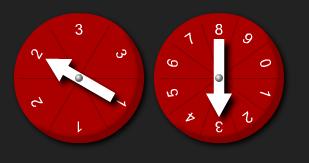
We did numbers more than $20$ and numbers less than $20$. Numbers more than $20$ won because there are four tens on the left spinner that would work but there are only two tens that would work for less than $20$.

Our Numbers
Age 5 to 7
Challenge Level 

Jacob and James from Fishergate Primary School played this game using our interactive spinners.
Using spinners $1-6$ and $0-9$ we tried to see who would win if one was even and one was odd. The odds won as we got these numbers.
| Numbers |
| 25 |
| 32 |
| 29 |
| 35 |
| 54 |
| 52 |
| 55 |
| 22 |
| 35 |
| 51 |
| 11 |
Then we found out the $3$ times table beat the $5$ times table.
| Numbers |
| 29 |
| 51 |
| 22 |
| 36 |
| 26 |
| 51 |
| 11 |
| 54 |
| 23 |
| 26 |
| 37 |
| 10 |
| 69 |
| 24 |
Someone else wrote in to tell us that they found that broad sets work well if you have to get one but narrower sets work better if you want to get them all. Jacob and James then tried different spinners.
We did numbers more than $20$ and numbers less than $20$. Numbers more than $20$ won because there are four tens on the left spinner that would work but there are only two tens that would work for less than $20$.
| Numbers |
| 37 |
| 24 |
| 38 |
| 14 |
| 14 |
| 28 |
| 11 |
| 30 |
| 23 |
You may also like

Let's Investigate Triangles
Vincent and Tara are making triangles with the class construction set. They have a pile of strips of different lengths. How many different triangles can they make?