Skip over navigation


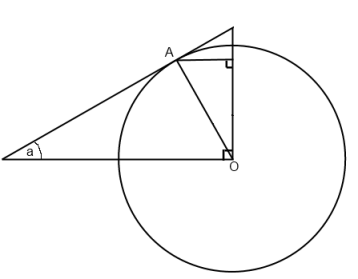 In this diagram OA is a radius of a unit circle. The hypotenuse of the large triangle is tangent to the circle at A.

Geometric Trig
Age 16 to 18
ShortChallenge Level 

In this diagram OA is a radius of a unit circle. The hypotenuse of the large triangle is tangent to the circle at A.Find the lengths $\cos(a)$, $\sin(a)$, $\tan(a)$, $\frac{1}{\cos(a)}$, $\frac{1}{\sin(a)}$ and $\frac{1}{\tan(a)}$ in the diagram.
Find the areas of all of the regions in the diagram.
Did you know ... ?
Whilst trigonometric functions are defined algebraically in more advanced applications, geometric images such as this one can give great insight into the relationships between the functions. They also impart a sense of the beauty and interconnectedness of mathematics, which inspires many students of mathematics.
Whilst trigonometric functions are defined algebraically in more advanced applications, geometric images such as this one can give great insight into the relationships between the functions. They also impart a sense of the beauty and interconnectedness of mathematics, which inspires many students of mathematics.
You may also like

Logosquares
Ten squares form regular rings either with adjacent or opposite vertices touching. Calculate the inner and outer radii of the rings that surround the squares.
Ball Bearings
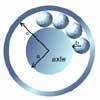
If a is the radius of the axle, b the radius of each ball-bearing, and c the radius of the hub, why does the number of ball bearings n determine the ratio c/a? Find a formula for c/a in terms of n.