Skip over navigation


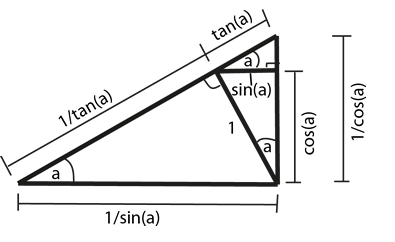
There are many ways to create the solution as it is something like a jigsaw. We used this method
1. Mark the right angles (use the fact the a radius and tangent at a point are at right angles)
2. Make all occurrences of the angle a
3. Mark the unit length
The diagram then becomes
To work out all of the areas we need to decide what unit of measurement the angle $a$ is in. Of course, we choose radians: there are $2\pi$ radians in a circle. We will also need to know the formula for the area of a circle and the area of a triangle. In this case, the areas are given as
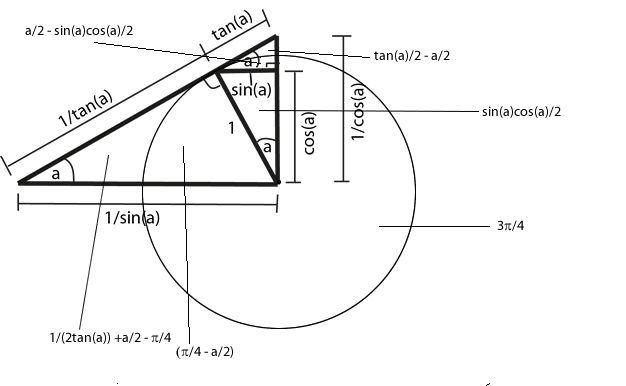
The two largest areas are equal for around 0.40523 radians (23.2 degrees).

Geometric Trig
Age 16 to 18
ShortChallenge Level 

There are many ways to create the solution as it is something like a jigsaw. We used this method
1. Mark the right angles (use the fact the a radius and tangent at a point are at right angles)
2. Make all occurrences of the angle a
3. Mark the unit length
The diagram then becomes
To work out all of the areas we need to decide what unit of measurement the angle $a$ is in. Of course, we choose radians: there are $2\pi$ radians in a circle. We will also need to know the formula for the area of a circle and the area of a triangle. In this case, the areas are given as
The two largest areas are equal for around 0.40523 radians (23.2 degrees).
You may also like

Logosquares
Ten squares form regular rings either with adjacent or opposite vertices touching. Calculate the inner and outer radii of the rings that surround the squares.
Ball Bearings
If a is the radius of the axle, b the radius of each ball-bearing, and c the radius of the hub, why does the number of ball bearings n determine the ratio c/a? Find a formula for c/a in terms of n.