Skip over navigation


We received a variety of solutions to each part of this problem. Patrick from Woodbridge School explained how he was surprised to find each child received the same amount, and went on to use a spreadsheet to investigate:
At first it seemed that the 5th child would obviously get most, but then I realised that in fact $\frac{1}{6}$ of the money is quite a lot. I then thought that they would all be very closely grouped with child 5 having slightly more. It was surprising to see that every child received £5.
I then adapted the spreadsheet for a varying number of children. I decided that since the denominator of the fraction was decreased by one, I would decrease the number of children by one, so I performed trial and error testing on sums of money equalling 1 mod 5 (I was assuming a simple case of the first child receiving a whole amount of money.) I got a good result with £16 shared between 4 children.
This seems to show a relationship: $\frac{1}{6}$ gives 5 children £5, $\frac{1}{5}$ gives 4 children £4. I decided to test this on the spreadsheet, and the pattern seems to hold that a fraction of $\frac{1}{n}$ gives $n-1$ children £$n-1$ each.
8 children means that $n = 9$ for my calculations, so $\frac{1}{9}$ must be used to share out $8 \times 8 = $ £$64$. I checked this and it worked.
Let there be $n$ children. We must show that $\frac{1}{n+1}$ is the fraction and the total sum of money is $n^2$.
First, to prove that child 1 gets £$n$: The fractional part of his sum is $\frac{n^2-1}{n+1}$, which reduces (because we have a difference of two squares as the numerator) to $n-1$.
Child 1 gets the fractional part plus £1, so his sum is $n-1+1 = n$.
In the case of child $a$, we know that $(a-1) \times n$ has been given out already, so the money left is $n^2-n(a-1)$. Therefore his sum is $\frac{n^2-n(a-1)-a}{n+1} + a$.
This simplifies to $\frac{n^2-na+n-a+an+a}{n+1}$, simplifying to $\frac{n^2+n}{n+1}$ and thence to $n$. Thus, every child gets £$n$ out of a prize fund of $n^2$, if the fraction used is $\frac{1}{n+1}$.
Joshua, from St John's Junior School, explained how you can always find an amount to share in this way with $n$ children:
This only works if you've got $n$ children, £$n^2$ and each time divide by $n+1$.
Child 1 receives: $$1 + \frac{n^2 -1}{n+1} = 1+ \frac{(n-1)(n+1)}{n+1} = 1 + (n-1) = n$$
Child 2 receives: $$2 + \frac{n^2 -n -2}{n+1} = \frac{2(n+1) + (n^2 - n -2)}{n+1} = \frac{n^2 +n}{n+1} = n$$
In general, child $a$ receives: $$a + \frac{n^2 - n(a-1) -a}{n+1} = \frac{n^2 - na + na + a - a + n}{n+1} = \frac{n^2+n}{n+1} = n$$
This means every child gets £n.
Harrison, from Caringbah High School, Australia, and Francois, from Abingdon School, both used simultaneous equations to find out how much Mrs Hobson had to share out. You can read Francois' solution here. Preveina from Crest Girls' Academy sent in this solution. Well done to all of you.
Fair Shares?
Age 14 to 16
Challenge Level 

We received a variety of solutions to each part of this problem. Patrick from Woodbridge School explained how he was surprised to find each child received the same amount, and went on to use a spreadsheet to investigate:
At first it seemed that the 5th child would obviously get most, but then I realised that in fact $\frac{1}{6}$ of the money is quite a lot. I then thought that they would all be very closely grouped with child 5 having slightly more. It was surprising to see that every child received £5.
I then adapted the spreadsheet for a varying number of children. I decided that since the denominator of the fraction was decreased by one, I would decrease the number of children by one, so I performed trial and error testing on sums of money equalling 1 mod 5 (I was assuming a simple case of the first child receiving a whole amount of money.) I got a good result with £16 shared between 4 children.
This seems to show a relationship: $\frac{1}{6}$ gives 5 children £5, $\frac{1}{5}$ gives 4 children £4. I decided to test this on the spreadsheet, and the pattern seems to hold that a fraction of $\frac{1}{n}$ gives $n-1$ children £$n-1$ each.
8 children means that $n = 9$ for my calculations, so $\frac{1}{9}$ must be used to share out $8 \times 8 = $ £$64$. I checked this and it worked.
Let there be $n$ children. We must show that $\frac{1}{n+1}$ is the fraction and the total sum of money is $n^2$.
First, to prove that child 1 gets £$n$: The fractional part of his sum is $\frac{n^2-1}{n+1}$, which reduces (because we have a difference of two squares as the numerator) to $n-1$.
Child 1 gets the fractional part plus £1, so his sum is $n-1+1 = n$.
In the case of child $a$, we know that $(a-1) \times n$ has been given out already, so the money left is $n^2-n(a-1)$. Therefore his sum is $\frac{n^2-n(a-1)-a}{n+1} + a$.
This simplifies to $\frac{n^2-na+n-a+an+a}{n+1}$, simplifying to $\frac{n^2+n}{n+1}$ and thence to $n$. Thus, every child gets £$n$ out of a prize fund of $n^2$, if the fraction used is $\frac{1}{n+1}$.
Joshua, from St John's Junior School, explained how you can always find an amount to share in this way with $n$ children:
This only works if you've got $n$ children, £$n^2$ and each time divide by $n+1$.
Child 1 receives: $$1 + \frac{n^2 -1}{n+1} = 1+ \frac{(n-1)(n+1)}{n+1} = 1 + (n-1) = n$$
Child 2 receives: $$2 + \frac{n^2 -n -2}{n+1} = \frac{2(n+1) + (n^2 - n -2)}{n+1} = \frac{n^2 +n}{n+1} = n$$
In general, child $a$ receives: $$a + \frac{n^2 - n(a-1) -a}{n+1} = \frac{n^2 - na + na + a - a + n}{n+1} = \frac{n^2+n}{n+1} = n$$
This means every child gets £n.
Harrison, from Caringbah High School, Australia, and Francois, from Abingdon School, both used simultaneous equations to find out how much Mrs Hobson had to share out. You can read Francois' solution here. Preveina from Crest Girls' Academy sent in this solution. Well done to all of you.
You may also like
There's a Limit
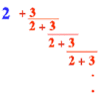
Explore the continued fraction: 2+3/(2+3/(2+3/2+...)) What do you notice when successive terms are taken? What happens to the terms if the fraction goes on indefinitely?
Not Continued Fractions
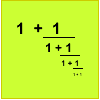
Which rational numbers cannot be written in the form x + 1/(y + 1/z) where x, y and z are integers?