

Follow the Numbers


From Year $4$ at Queen Edith School, Cambridge we had the following rather good idea sent in.
After we had got the idea of following a number on its journey, we split up the work of checking out lots of numbers. Some of us began with numbers in the $30$s, some with numbers in the $40$s, and so on.
We found that all the numbers we tried ended up on one of three journeys:
$2, 4, 8, 16, 14, 10, 2, 4, 8,$ ... which we called the "red" journey
$6, 12, 6, 12,$ ... which we called the "green" journey
$18, 18, 18,$ ... which we called the "blue" journey
Next, we used a $100$ square on the Smartboard, and coloured the numbers to match their journeys. After we had coloured a few of the numbers, some of us spotted patterns beginning to show, like the blue diagonal from $81$ up to $9$. We predicted that other numbers on the diagonal would also be blue and checked them out. We also saw green squares along diagonals and made more predictions.
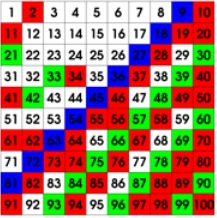
Finally, we made a display using the 100 square and some of our work to challenge other children to predict the journeys for some of the squares we had not coloured.
Can you predict a journey and then check if you were right?
From Krystof in Prague and Matthew from Hamworthy Middle School we had had similar results. From Karin in West Acton in London we had a clever further idea sent in.
My rule for "Follow the Numbers" is to work out the difference between the $2$ digits and add $5$ to the difference.
Here is some of my "Follow the Numbers"
Starting number:$24 24,07,12,06,11,05,10,06...$
Starting number:$39 39,11,05,10,06,11...$
Starting number:$83 83,10,06,11,05,10...$
Starting number:$63 63,08,13,07,12,06,11,05,10,06... $
On my "Follow the Numbers", most of my numbers had a pattern of $08,13,07,12,06,11,05,10,06.$
Well done Karin, I like this very much, others of you could try your own rules.
You may also like
Triple Cubes
This challenge involves eight three-cube models made from interlocking cubes. Investigate different ways of putting the models together then compare your constructions.
Inky Cube
This cube has ink on each face which leaves marks on paper as it is rolled. Can you work out what is on each face and the route it has taken?
The Car That Passes
What statements can you make about the car that passes the school gates at 11am on Monday? How will you come up with statements and test your ideas?