Skip over navigation


Digital photos may be a good way of recording the children's constructions. You could then use the photos as a stimulus for conversations in small groups or with individuals at a later date.

Triple Cubes
Age 5 to 11
Challenge Level 

Triple Cubes
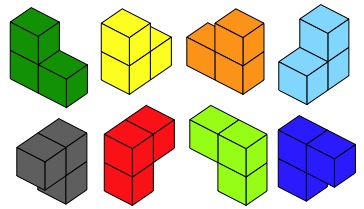
Well, here I've placed a group of cubes. They are in threes and coloured differently.
What do you notice about them?
You could get $8$ triple cubes like these, each triple a different colour. Don't separate the triple but use them as building blocks to see what you can make.
For some of you it would be good to keep the eight triple cubes facing their own ways and not turn them around. In this way we keep eight arrangements that are different.
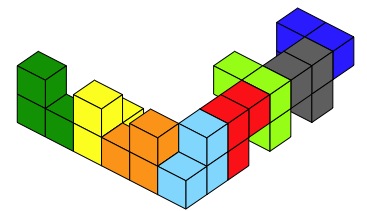
We can now use these as building blocks to make interesting arrangements and shapes. Here is one to start us off.
Notice how I've joined them together with square faces touching. This might be the way that you decide to build.
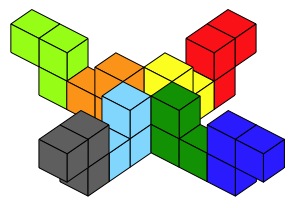
Or, you may include some "edge" joining as in this one.
So now it's your turn to see what you can make from these eight triple cubes.
Why do this problem?
This activity is an engaging one which may give opportunities for pupils to expand their spatial capabilities. It uses non-standard shapes which must be put together, and so it stretches the imagination. Pupils will probably have had some experience of various construction materials, and this offers something just a bit
different.
Possible approach
Having prepared interlocking cubes in eight different colours, invite one pupil in the group to select one, then another child to choose another and connect it in some way to the first. Then invite a third child to choose another and connect it, etc. When all eight pieces are assembled together, pose questions and prompts such as: "Tell me about this."; "What do you see?"; "Any ideas as
to what this could be?" ...etc. Try to use open questions which will not stifle creativity or be too directive.
Give children the chance to have a go on their own or in pairs. Plenty of interlocking cubes will be needed! Listen out for the way they describe their models and how they communicate with each other. Are they using appropriate vocabulary? Are they able to articulate where they are going to put the next shape? How are they going about the task?
Key questions
When they are making their own:
Tell me about this.
What are you making?
Do you have a name for this?
(Looking at theirs next to yours) Tell me about them.
Possible extension
You could challenge some children to make:
the longest one;
the one with most/least area touching the ground;
a mirror image of someone else's (including the colours);
the longest shape that can be picked up by holding just one cube.
Possible support
Some pupils may want to start with just four triple cubes and explore those first.
You may also like
Triangle Animals
How many different ways can you find to join three equilateral triangles together? Can you convince us that you have found them all?
The Add and Take-away Path
Two children made up a game as they walked along the garden paths. Can you find out their scores? Can you find some paths of your own?