Skip over navigation


James from Wilson's School told us something he'd noticed about the second, third and fourth vectors forming a square park:
The vector journey goes: $\pmatrix{3\cr 1} \pmatrix{-1\cr 3} \pmatrix{-3\cr -1} \pmatrix{1\cr -3}$
After finding the first vector both top and bottom numbers should be positive, next vector the top number is made negative then next vector both numbers are negative and finally the last vector the bottom number is negative. The second and last vectors the left/right number switches with the up/down number.
Elliott, also from Wilson's, made some observations:
Charlie walks on vectors of $\pmatrix{3\cr 1} \pmatrix{-1\cr 3} \pmatrix{-3\cr -1} \pmatrix{1\cr -3}$
Another square he could walk would have vectors of $\pmatrix{5\cr 2} \pmatrix{-2\cr 5} \pmatrix{-5\cr -2} \pmatrix{2\cr -5}$
These vectors must only consist of four numbers: $x, y, -x$ and $-y$.
It can only be two numbers, and their negatives, so that all the sides of the square are equal in length.
After travelling along the first vector, you can then move left or right. From there, you must do the opposite of your first move, then the opposite of your second, to get back to your original position.
Josephine from The Urswick School added:
The vectors must add up to zero.
Niharika from Leicester High School for Girls sent us this solution. Well done to you all.
Vector Journeys
Age 14 to 18
Challenge Level 

James from Wilson's School told us something he'd noticed about the second, third and fourth vectors forming a square park:
The vector journey goes: $\pmatrix{3\cr 1} \pmatrix{-1\cr 3} \pmatrix{-3\cr -1} \pmatrix{1\cr -3}$
After finding the first vector both top and bottom numbers should be positive, next vector the top number is made negative then next vector both numbers are negative and finally the last vector the bottom number is negative. The second and last vectors the left/right number switches with the up/down number.
Elliott, also from Wilson's, made some observations:
Charlie walks on vectors of $\pmatrix{3\cr 1} \pmatrix{-1\cr 3} \pmatrix{-3\cr -1} \pmatrix{1\cr -3}$
Another square he could walk would have vectors of $\pmatrix{5\cr 2} \pmatrix{-2\cr 5} \pmatrix{-5\cr -2} \pmatrix{2\cr -5}$
These vectors must only consist of four numbers: $x, y, -x$ and $-y$.
It can only be two numbers, and their negatives, so that all the sides of the square are equal in length.
After travelling along the first vector, you can then move left or right. From there, you must do the opposite of your first move, then the opposite of your second, to get back to your original position.
Josephine from The Urswick School added:
The vectors must add up to zero.
Niharika from Leicester High School for Girls sent us this solution. Well done to you all.
You may also like
Flexi Quads
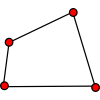
A quadrilateral changes shape with the edge lengths constant. Show the scalar product of the diagonals is constant. If the diagonals are perpendicular in one position are they always perpendicular?
A Knight's Journey
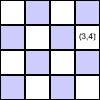
This article looks at knight's moves on a chess board and introduces you to the idea of vectors and vector addition.
8 Methods for Three by One
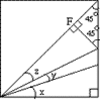
This problem in geometry has been solved in no less than EIGHT ways by a pair of students. How would you solve it? How many of their solutions can you follow? How are they the same or different? Which do you like best?