Skip over navigation


This problem introduces hyperbolic functions in an intriguing way which emphasises the natural links with trigonometric functions. It is a fairly well-signposted investigation which will provide practice in manipulation of powers, an understanding of the hyperbolic function identities and the importance of the base $e$ in the definitions. It also refreshes an area of the curriculum which can often feel dry or jaded - as the teacher, you might find some of the conclusions surprising or interesting (Steve certainly did, when he crafted the problem!).
You can use this problem as an introduction to hyperbolic functions or, with slight changes, as a consolidation of the topic. In both cases it will give a solid consolidation of the properties of the trigonometric functions. Here we give some suggestions for using the task to introduce hyperbolic functions.
Firstly project the page from Steve's notepad and give students a chance to read it. Open the discussion by asking 'Does anyone have any idea why Steve seems to think that these are like sine and cosine?'. Some students might note the similarities to the definition of sine and cosine in terms of exponentials, but this is not necessary prior knowledge. If nobody knows or spots the link, mention that it will be interesting to find out what the connection is! Even if the link is spotted, there are clearly significant differences between the two pairs of functions, which will make for an interesting analysis.
To address the main question, start by collectively listing as many of the properties of sine and cosine as possible - for your reference, the full list to aim for is that given in the question trig reps, but initially stick with those suggested by the students (Note that these properties fall into three rough categories: algebraic identities; differentiability properties; particular values.)
NOTE: It is not intended that students tackle this problem graphically. Pen, paper and analytical reasoning are the intended tools.
Once these have been collected encourage students to explore the properties of the functions $A(x)$ and $B(x)$, using the properties of the trig functions as a guide - give the class a nudge by suggesting that this might involve trying a few values, differentiating, squaring and adding, subtracting and so on.
You might want to draw up a table along these lines on the board which you get students to fill in individually or collectively as you see fit.
Once the similarities and differences have been explored you might turn to the question of the base: in which areas is the base important? Is there a 'natural' choice of base? This sets the stage very nicely for the formal definitions of the hyperbolic functions.
(use these only as prompts if the group is struggling to get started)
Compute and simplify $A^2(x), B^2(x), A(x)B(x), A(2x), B(2x)$. Can you spot any simple connections between these expressions?
What happens if you try to differentiate $A(x)$ and $B(x)$?
A fascinating related question is this: Is there an algebraic representation of sine and cosine if they are measured in degrees? Can you produce a 'family' of trigonometric-like functions? Alternatively, you might pose the question 'what if the $10$ is replaced by $i$?'.
You can explicity ask "Can you work out $A^2(x)-B^2(x)?$" and "Can you relate $A(2x)$ to $A(x)$ and $B(x)$?. You might also need to show students how to differentiate $10^x$ if they have forgotten or don't yet know.


Hyperbolic Thinking
Age 16 to 18
Challenge Level 

Why do this problem
This problem introduces hyperbolic functions in an intriguing way which emphasises the natural links with trigonometric functions. It is a fairly well-signposted investigation which will provide practice in manipulation of powers, an understanding of the hyperbolic function identities and the importance of the base $e$ in the definitions. It also refreshes an area of the curriculum which can often feel dry or jaded - as the teacher, you might find some of the conclusions surprising or interesting (Steve certainly did, when he crafted the problem!).
Possible approach
You can use this problem as an introduction to hyperbolic functions or, with slight changes, as a consolidation of the topic. In both cases it will give a solid consolidation of the properties of the trigonometric functions. Here we give some suggestions for using the task to introduce hyperbolic functions.
Firstly project the page from Steve's notepad and give students a chance to read it. Open the discussion by asking 'Does anyone have any idea why Steve seems to think that these are like sine and cosine?'. Some students might note the similarities to the definition of sine and cosine in terms of exponentials, but this is not necessary prior knowledge. If nobody knows or spots the link, mention that it will be interesting to find out what the connection is! Even if the link is spotted, there are clearly significant differences between the two pairs of functions, which will make for an interesting analysis.
To address the main question, start by collectively listing as many of the properties of sine and cosine as possible - for your reference, the full list to aim for is that given in the question trig reps, but initially stick with those suggested by the students (Note that these properties fall into three rough categories: algebraic identities; differentiability properties; particular values.)
NOTE: It is not intended that students tackle this problem graphically. Pen, paper and analytical reasoning are the intended tools.
Once these have been collected encourage students to explore the properties of the functions $A(x)$ and $B(x)$, using the properties of the trig functions as a guide - give the class a nudge by suggesting that this might involve trying a few values, differentiating, squaring and adding, subtracting and so on.
You might want to draw up a table along these lines on the board which you get students to fill in individually or collectively as you see fit.
| Trigonometric property | Similar property of $A(x)$ and $B(x)$ | Similar or rather different? |
| $\cos(x)^2+\sin(x)^2 =1$ | ||
| $\cos(0) =1 ,\quad \sin(0)=0$ | ||
| $\cos(2x) = 2\cos^2(x)-1$ | ||
| $|\cos(x)|\leq 1, \quad |\sin(x)|\leq 1$ | ||
| $\frac{d}{dx}(\sin(x)) = \cos(x), \quad \frac{d}{dx}(\cos(x)) = -\sin(x)$ | ||
| etc ... |
Once the similarities and differences have been explored you might turn to the question of the base: in which areas is the base important? Is there a 'natural' choice of base? This sets the stage very nicely for the formal definitions of the hyperbolic functions.
Key questions
(use these only as prompts if the group is struggling to get started)
Compute and simplify $A^2(x), B^2(x), A(x)B(x), A(2x), B(2x)$. Can you spot any simple connections between these expressions?
What happens if you try to differentiate $A(x)$ and $B(x)$?
Possible extension
A fascinating related question is this: Is there an algebraic representation of sine and cosine if they are measured in degrees? Can you produce a 'family' of trigonometric-like functions? Alternatively, you might pose the question 'what if the $10$ is replaced by $i$?'.
Possible support
You can explicity ask "Can you work out $A^2(x)-B^2(x)?$" and "Can you relate $A(2x)$ to $A(x)$ and $B(x)$?. You might also need to show students how to differentiate $10^x$ if they have forgotten or don't yet know.
You may also like
Big, Bigger, Biggest
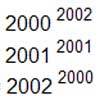
Which is the biggest and which the smallest of $2000^{2002}, 2001^{2001} \text{and } 2002^{2000}$?
Infinite Continued Fractions
In this article we are going to look at infinite continued fractions - continued fractions that do not terminate.
Gosh Cosh
Explore the hyperbolic functions sinh and cosh using what you know about the exponential function.