Skip over navigation
Cambridge University Faculty of Mathematics NRich logo
menu search
  • Teachers expand_more
    • Early years
    • Primary
    • Secondary
    • Post-16
    • Events
    • Professional development
  • Students expand_more
    • Primary
    • Secondary
    • Post-16
  • Parents expand_more
    • Early Years
    • Primary
    • Secondary
    • Post-16
  • Problem-Solving Schools
  • About NRICH expand_more
    • About us
    • Impact stories
    • Support us
    • Our funders
    • Contact us
  • search

Or search by topic

Number and algebra

  • The Number System and Place Value
  • Calculations and Numerical Methods
  • Fractions, Decimals, Percentages, Ratio and Proportion
  • Properties of Numbers
  • Patterns, Sequences and Structure
  • Algebraic expressions, equations and formulae
  • Coordinates, Functions and Graphs

Geometry and measure

  • Angles, Polygons, and Geometrical Proof
  • 3D Geometry, Shape and Space
  • Measuring and calculating with units
  • Transformations and constructions
  • Pythagoras and Trigonometry
  • Vectors and Matrices

Probability and statistics

  • Handling, Processing and Representing Data
  • Probability

Working mathematically

  • Thinking mathematically
  • Developing positive attitudes
  • Cross-curricular contexts

Advanced mathematics

  • Decision Mathematics and Combinatorics
  • Advanced Probability and Statistics
  • Mechanics
  • Calculus

For younger learners

  • Early Years Foundation Stage

Two and Two

Age 11 to 16
Challenge Level Yellow starYellow starYellow star
Primary curriculum
Secondary curriculum
  • Problem
  • Getting Started
  • Student Solutions
  • Teachers' Resources

Why do this problem?


This problem offers an opportunity to practise addition in a more interesting and challenging context than is usual. It requires students to work systematically, record their progress efficiently and apply their understanding of place value.


Possible approach


This printable worksheet may be useful: Two and Two

Write the following sum on the board and ask students to complete it.
 
    8 6 1
+   ? ? ?
  1 4 2 7

Expect justifications for any suggestions.
This should be unproblematic so move onto a more challenging problem.
 
If each letter stands for a distinct digit what are the values of $a$, $b$ and $c$?
 
  b b
+ c b
a c c

"How can we approach this?"
Expect fairly random suggestions to start with but aim to use the discussion as an opportunity to model working systematically.
"What happens if $b$ is $1, 2, 3, \ldots$ ?" - rejecting values as soon as it is apparent they do not work and discussing how you know.
"How can we be sure we have all the solutions?"
 
Set the students off in pairs to work on the problem TWO + TWO = FOUR
 
Establish that you are not going to announce how many solutions there are and that you will expect students to work systematically and be able to justify that they have all the possible solutions.

To finish off, students could present their approach to the rest of the class, with emphasis on explaining clearly why they are convinced that they have found all the possible solutions.


Key questions

What must "F" be?
What does that tell you about "T"?
Are you certain you have considered all the possibilities?
 

Possible support


Suggest students start with Spell by Numbers


Possible extension


Suggest students find other word sums that work.

Here are some possibilities that they might consider:
 

ONE + ONE = TWO
ONE + TWO = THREE
ONE + THREE = FOUR
FOUR + FIVE = NINE
 

Why are some impossible?

Can they make a word subtraction?

Students could also try Cryptarithms and Kangaroo Subtraction


Related Collections

  • Working Systematically - Lower Secondary
  • Working Systematically - short problems

You may also like

Double Digit

Choose two digits and arrange them to make two double-digit numbers. Now add your double-digit numbers. Now add your single digit numbers. Divide your double-digit answer by your single-digit answer. Try lots of examples. What happens? Can you explain it?
DOTS Division

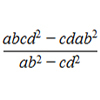
Take any pair of two digit numbers x=ab and y=cd where, without loss of generality, ab > cd . Form two 4 digit numbers r=abcd and s=cdab and calculate: {r^2 - s^2} /{x^2 - y^2}.

Novemberish

a) A four digit number (in base 10) aabb is a perfect square. Discuss ways of systematically finding this number. (b) Prove that 11^{10}-1 is divisible by 100.

  • Tech help
  • Accessibility Statement
  • Sign up to our newsletter
  • Twitter X logo

The NRICH Project aims to enrich the mathematical experiences of all learners. To support this aim, members of the NRICH team work in a wide range of capacities, including providing professional development for teachers wishing to embed rich mathematical tasks into everyday classroom practice.

NRICH is part of the family of activities in the Millennium Mathematics Project.

University of Cambridge logo NRICH logo