Skip over navigation


Puzzling Place Value
Age 14 to 16
Challenge Level 

You may wish to look at Always a Multiple and Reversals before tackling this problem.
For these problems, use the digits from $1$ to $9$
We are using $ABC$ to represent a 3 digit number with $A$ hundreds, $B$ tens and $C$ units. Similarly, $AB$ represents a 2 digit number with $A$ tens and $B$ units.
For these problems, use the digits from $1$ to $9$
We are using $ABC$ to represent a 3 digit number with $A$ hundreds, $B$ tens and $C$ units. Similarly, $AB$ represents a 2 digit number with $A$ tens and $B$ units.
Problem 1:
A positive 2 digit integer $AB$ is four times the sum of its digits.
Prove that there are exactly four such numbers $AB$.
Prove that there are exactly four such numbers $AB$.
Problem 2:
Show that there is only one set of values $A, B$ and $C$ that satisfies $$ABC + AB + C = 300$$
Problem 3:
Choose a two-digit number with two different digits (e.g. $47$) and form its reversal (i.e. 74). Now, subtract the sum of the digits from each of these numbers, and then add the two results. Show that you always obtain a multiple of $9$.
Problem 4:
Choose three different digits and form the six two-digit numbers that use two of the three digits. Add these six possibilities and divide this total by the sum of the three digits. Show that you always obtain $22$.
Problem 5:
Choose three different digits $A, B$ and $C$, with $A > B > C$ (e.g. $8, 6$ and $3$).
Work out the differences between the two-digit numbers you can make and their reverses (e.g. $86-68; 63-36; 83-38$), then add these three results.
Show that you always obtain a multiple of $18$.
Work out the differences between the two-digit numbers you can make and their reverses (e.g. $86-68; 63-36; 83-38$), then add these three results.
Show that you always obtain a multiple of $18$.
Problem 6:
For any three digits $A, B$ and $C$, show that there is only set of values that satisfies $$ABC=AB+BC+CA.$$
Problem 7:
Find examples that fit the rule: $$AB+CD=DC+BA,$$ without any of the four digits being the same (e.g. $97+24=42+79$).
What general rule must apply? Why?
With thanks to Don Steward, whose ideas formed the basis of this problem.
What general rule must apply? Why?
With thanks to Don Steward, whose ideas formed the basis of this problem.
You may also like

DOTS Division
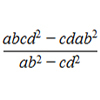
Take any pair of two digit numbers x=ab and y=cd where, without loss of generality, ab > cd . Form two 4 digit numbers r=abcd and s=cdab and calculate: {r^2 - s^2} /{x^2 - y^2}.
Sixational
The nth term of a sequence is given by the formula n^3 + 11n. Find the first four terms of the sequence given by this formula and the first term of the sequence which is bigger than one million. Prove that all terms of the sequence are divisible by 6.