
Skip over navigation
Cambridge University Faculty of Mathematics NRich logo
menu search
  • Teachers expand_more
    • Early years
    • Primary
    • Secondary
    • Post-16
    • Events
    • Professional development
  • Students expand_more
    • Primary
    • Secondary
    • Post-16
  • Parents expand_more
    • Early Years
    • Primary
    • Secondary
    • Post-16
  • Problem-Solving Schools
  • About NRICH expand_more
    • About us
    • Impact stories
    • Support us
    • Our funders
    • Contact us
  • search

Or search by topic

Number and algebra

  • The Number System and Place Value
  • Calculations and Numerical Methods
  • Fractions, Decimals, Percentages, Ratio and Proportion
  • Properties of Numbers
  • Patterns, Sequences and Structure
  • Algebraic expressions, equations and formulae
  • Coordinates, Functions and Graphs

Geometry and measure

  • Angles, Polygons, and Geometrical Proof
  • 3D Geometry, Shape and Space
  • Measuring and calculating with units
  • Transformations and constructions
  • Pythagoras and Trigonometry
  • Vectors and Matrices

Probability and statistics

  • Handling, Processing and Representing Data
  • Probability

Working mathematically

  • Thinking mathematically
  • Developing positive attitudes
  • Cross-curricular contexts

Advanced mathematics

  • Decision Mathematics and Combinatorics
  • Advanced Probability and Statistics
  • Mechanics
  • Calculus

For younger learners

  • Early Years Foundation Stage

Amicable Arrangements

Age 16 to 18
Challenge Level Yellow starYellow star
  • Problem
  • Getting Started
  • Student Solutions
  • Teachers' Resources

Three elves who work at Santa's factory are having a festive feast, and each one invites their best friend who works at the University of the North Pole. The three elves and their besties sit down at a round table. All of the possible seating arrangements of the six party-goers are equally likely.

(a) Show that the probability that each elf sits next to their bestie is $\frac 2 {15}$.  

A good first step is to decide on some notation. Perhaps $E_1, E_2, E_3$ for the elves and $B_1, B_2, B_3$ for the associated best friends, so that $B_1$ is the best friend of $E_1$ etc.

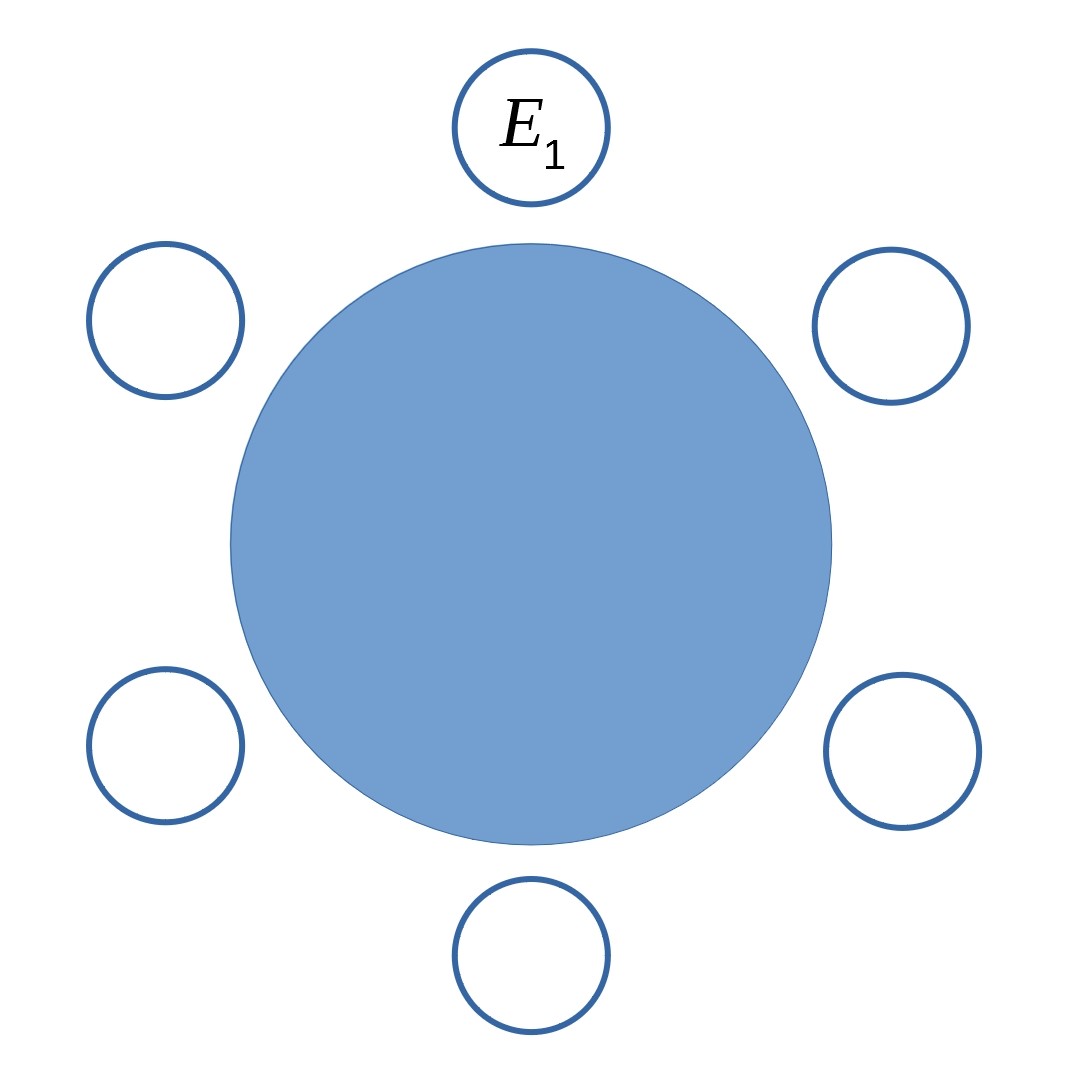
This is a round table, so we can use symmetry to simplify the problem a bit.  We can think of $E_1$ as being in a fixed seat, and then only have to worry about the positions of the other five party-goers.  How many ways can you arrange five people?

You might find that diagrams (like the one below) are helpful.

There are some more hints for this part in the Getting Started section.

(b) Find the probability that exactly two of Santa's elves sit next to their best friends.  

You can start by considering the case when $E_1$ and $B_1$ are separated (and so $E_2$ and $B_2$ sit together, and $E_3$ and $B_3$ sit together).

In the diagram below, which of the seats can $B_1$ not sit in if we are to have $E_1$ and $B_1$ separated?  Are there any seats which mean that $E_1$ and $B_1$ are separated, but we cannot sit the other four elves in two pairs?  How many seats can $B_1$ actually sit in?
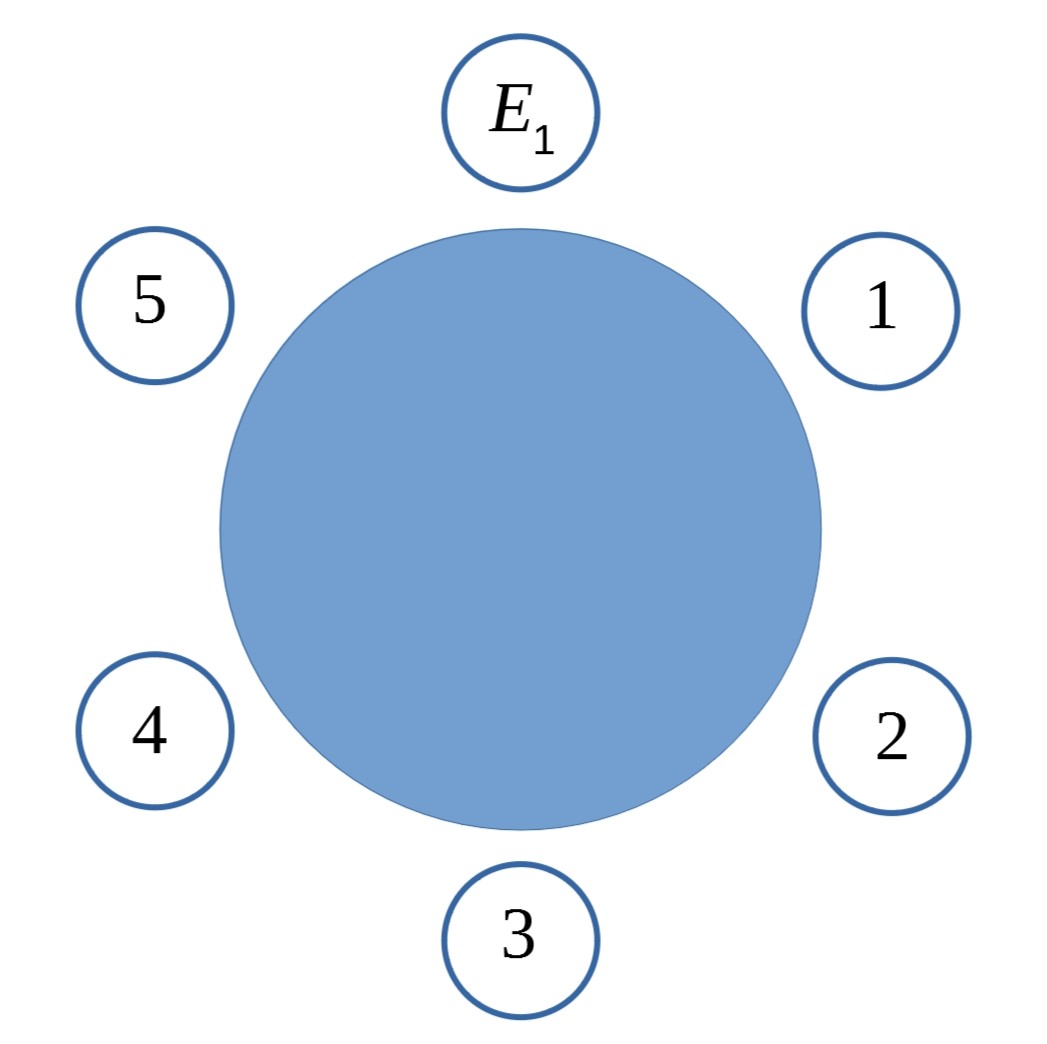


How many options are there for the other seats?  Maybe start with seat $1$?

Once you have found the number of ways of keeping $E_1$ and $B_1$ separated but the other two pairs are together, you can use symmetry to find the number of ways of keeping $E_2$ and $B_2$ or $E_3$ and $B_3$ separated.

(c) Find the probability that no elf sits next to their best friend.

If no elf can sit next to their best friend, in how many seats could $B_1$ sit in?  In each of these cases, how many ways are there are arranging the other $4$ people? 


Based on STEP Mathematics I, 2008, Q13. Question reproduced by kind permission of Cambridge Assessment Group Archives. The question remains Copyright University of Cambridge Local Examinations Syndicate ("UCLES"), All rights reserved.

You may also like

Curvy Equation

This problem asks you to use your curve sketching knowledge to find all the solutions to an equation.

Digital Equation

Can you find a three digit number which is equal to the sum of the hundreds digit, the square of the tens digit and the cube of the units digit?

Euler's Totient Function

How many numbers are there less than $n$ which have no common factors with $n$?

  • Tech help
  • Accessibility Statement
  • Sign up to our newsletter
  • Twitter X logo

The NRICH Project aims to enrich the mathematical experiences of all learners. To support this aim, members of the NRICH team work in a wide range of capacities, including providing professional development for teachers wishing to embed rich mathematical tasks into everyday classroom practice.

NRICH is part of the family of activities in the Millennium Mathematics Project.

University of Cambridge logo NRICH logo