

Data Chunks


The situation : You have access to a communications link which you share with other users.
The link sends a stream of data in pulses at set intervals - a little like an escalator where each step carries a character.
The data you need to send comes in chunks of two different sizes - a yellow chunk has $5$ characters and a blue chunk has $9$ characters.
Slots in the data stream become available and you have to decide if you can use them efficiently with your yellow and blue data chunks.
For example a $180$ character slot could take $20$ blue chunks.
And a $78$ character slot could take $3$ yellow and $7$ blue chunks.
Slots come up very frequently so its only worth taking the ones you can fill exactly.
For example a slot of size $31$ cannot be exactly filled with a combination of yellow and blue chunks.
Begin by exploring what slot sizes near to $31$ can, or cannot, be exactly filled.
Don't rush that, but when you have a good feel for the problem move on to generalise this situation.
Your two chunks are not necessarily lengths of $5$ or $9$ characters.
Whatever two lengths you choose there will be slot sizes you cannot exactly fill.
Investigate how the two chunk lengths determine the slot sizes that will or will not work.
Describe your findings
You may find the Excel file Data Chunks useful.
If you spend a moment looking at the numbers you'll soon see how this spreadsheet file works.
There is also something you should know about spreadsheets and mathematical thinking:
Using ICT is often brilliant for getting lots of results fast, leaving your mind free to think about what's going on, but doing some calculating yourself gives you an on-the-ground feel for the process.
So the trick is to use both approaches, getting the benefit from each.
The Data Chunks problem is a challenge.
It takes time and determination, but if you've enjoyed wrestling with it then we feel confident that you'll want to see these links below.
There is an NRICH article by Alan and Toni Beardon about Euclid's Algorithm.
Click for Part One then there's a Part Two to take you on further.
Another article, this time by Vicky Neale and Matthew Buckley is about Modular Arithmetic
Yet another by Vicky is called Introductory Number Theory
Enjoy.
You may also like

Euler's Squares
Euler found four whole numbers such that the sum of any two of the numbers is a perfect square...

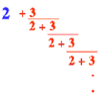
There's a Limit
Explore the continued fraction: 2+3/(2+3/(2+3/2+...)) What do you notice when successive terms are taken? What happens to the terms if the fraction goes on indefinitely?