Skip over navigation


There are many ways to solve this problem. See the Hints for suggestions of other lines of investigation you might like to pursue to find other solutions.
Andrei from Tudor Vianu National College, Bucharest, Romania has come up with an unexpected arrangement of the sticks. Here is Andrei's solution:
The length of the chord determined by the central angle $x$ in the
circle of unit radius is : $$L = 2 \sin \left({x\over 2}\right) =
1.829$$ It is evident that $L$ is greater than the distance between
the two parallel chords and is less than the diameter so that the
problem has a solution.
Spokes
Age 16 to 18
Challenge Level 
There are many ways to solve this problem. See the Hints for suggestions of other lines of investigation you might like to pursue to find other solutions.
Andrei from Tudor Vianu National College, Bucharest, Romania has come up with an unexpected arrangement of the sticks. Here is Andrei's solution:
|
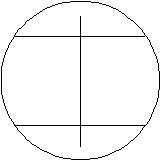
I chose to make $2$ segments of the unit, each of area a
quarter of the unit circle, and the remained part of the circle to
be divided into two equal parts, as shown in the figure.
Let $x$ be the central angle determined by the segment. The
area of the segment is: $${1\over 2}\left(x - \sin x\right).$$ And
it must be a quarter the area of the circle so: $${1\over 2}\left(x
- \sin x\right)= {\pi \over 4} .$$
|
 |
This equation could be solved only numerically, and to find an
approximate solution I represent the function $x-\sin x - {\pi
\over 2}$ and I look for a change of sign.
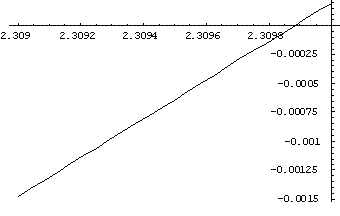 |
To find a better approximation I used this graph.
Plot $\left[x - \sin [x]- {\pi \over 2}, {x, 2.309,
2.31}\right]$
So $x \approx 2.3099$.
|
You may also like
Mean Geometrically
A and B are two points on a circle centre O. Tangents at A and B cut at C. CO cuts the circle at D. What is the relationship between areas of ADBO, ABO and ACBO?
Approximating Pi
By inscribing a circle in a square and then a square in a circle find an approximation to pi. By using a hexagon, can you improve on the approximation?