Skip over navigation


Impossible Square?
Age 16 to 18
Challenge Level 

Why do this problem
This question is a nice introduction to the concept of proof by contradiction: something concrete (the area of a square) is calculated in two different ways, and these ways are shown to be inconsistent.Possible approach
This problem could be offered with no advice. Students may
experiment with the ideas of visual proofs before realising that
they will need to look at an algebraic solution.
Once the algebra has led to the solution, it is a useful
exercise to ask students to explain in words why the absurdity
leads to the rejection of the square shape, rather than the
rejection of one of the methods of calculation or the rejection of
some of their assumptions concerning the base triangles or the
concept of area.
If the students believe that the square shape is impossible,
they could be pressed on why they are so sure of their methods of
calculation. Such discussion may lead to an increased appreciation
of the need for axioms in mathematics which are statements
that are agreed by all to be true and from
which all else follows.
Key Questions
What formulas for area will we need to use in this
question?
How can we relate these two formulas?
[once someone claims to have solved the problem] Can you
explain to the class why we cannot make a square?
Possible extensions
For the interested student, the article Proof by Contradiction offers
interesting and stimulating reading on the concept of proof by
contradiction.
Alternatively, students could try to experiment to find other
shapes which cannot be made from the triangles. For example,
- Which rectangles is it possible to make using these triangles?
- How many orientations of triangle are possible in a general completed jigsaw?
Possible support
To get started, why not try the simpler related problem The Square HoleRelated Collections
You may also like
Circles Ad Infinitum
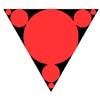
A circle is inscribed in an equilateral triangle. Smaller circles touch it and the sides of the triangle, the process continuing indefinitely. What is the sum of the areas of all the circles?

Climbing Powers
$2\wedge 3\wedge 4$ could be $(2^3)^4$ or $2^{(3^4)}$. Does it make any difference? For both definitions, which is bigger: $r\wedge r\wedge r\wedge r\dots$ where the powers of $r$ go on for ever, or $(r^r)^r$, where $r$ is $\sqrt{2}$?