Skip over navigation


Oliver has been experimenting with quadratic equations of the form: $$y=ax^2+2bx+c$$ Oliver chose values of $a, b$ and $c$ by taking three consecutive terms from the sequence: $$1, 2, 4, 8, 16, 32...$$ Try plotting some graphs based on Oliver's quadratic equations, for different sets of consecutive terms from his sequence.
Do you notice anything interesting?
Can you make any generalisations? Can you prove them?
Oliver's sequence is an example of a geometrical sequence, created by taking a number and then repeatedly multiplying by a common ratio. Oliver's sequence starts at $1$ and has common ratio $2$ (each number in the sequence is $2$ times the previous number).
Create some more geometrical sequences and substitute consecutive terms into Oliver's quadratic equation.
Here are some questions you might like to explore:
Can you make any predictions about the graph from the geometric sequence you use to generate the equation?
What if the common ratio is a fraction, or a negative number?
What if the starting number for your geometric sequence is a fraction, or a negative number?
Can you make any generalisations? Can you prove them?
You may wish to use graphing software such as the free-to-download Geogebra to investigate the graphs.


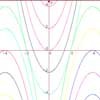
Geometric Parabola
Age 14 to 16
Challenge Level 
Oliver has been experimenting with quadratic equations of the form: $$y=ax^2+2bx+c$$ Oliver chose values of $a, b$ and $c$ by taking three consecutive terms from the sequence: $$1, 2, 4, 8, 16, 32...$$ Try plotting some graphs based on Oliver's quadratic equations, for different sets of consecutive terms from his sequence.
Do you notice anything interesting?
Can you make any generalisations? Can you prove them?
Oliver's sequence is an example of a geometrical sequence, created by taking a number and then repeatedly multiplying by a common ratio. Oliver's sequence starts at $1$ and has common ratio $2$ (each number in the sequence is $2$ times the previous number).
Create some more geometrical sequences and substitute consecutive terms into Oliver's quadratic equation.
Here are some questions you might like to explore:
Can you make any predictions about the graph from the geometric sequence you use to generate the equation?
What if the common ratio is a fraction, or a negative number?
What if the starting number for your geometric sequence is a fraction, or a negative number?
Can you make any generalisations? Can you prove them?
You may wish to use graphing software such as the free-to-download Geogebra to investigate the graphs.
You may also like
Converse
Clearly if a, b and c are the lengths of the sides of an equilateral triangle then a^2 + b^2 + c^2 = ab + bc + ca. Is the converse true?
Consecutive Squares
The squares of any 8 consecutive numbers can be arranged into two sets of four numbers with the same sum. True of false?
Parabolic Patterns
The illustration shows the graphs of fifteen functions. Two of them have equations y=x^2 and y=-(x-4)^2. Find the equations of all the other graphs.