Skip over navigation


Start with $a=1, b=2, c=4$ - what does the graph look like? What key points does it pass through?
Then try $a=2, b=4, c=8$, $a=4, b=8, c=16$ and so on. Look for similarities and differences between the graphs.

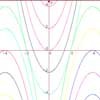
Geometric Parabola
Age 14 to 16
Challenge Level 
Why do this problem?
This month's NRICH site has been inspired by the way teachers at Kingsfield School in Bristol work with their students. Following an introduction to a potentially rich starting point, a considerable proportion of the lesson time at Kingsfield is dedicated to working on questions, ideas and conjectures generated by students.
It links the idea of a geometric sequence with analysis of a parabola and can lead to generalisations from the graphs that can be proved algebraically.
Possible approach
The activity could work well with students working in small groups. Each group could take a different geometric sequence and then formulate several equations of the form $y=ax^2+2bx+c$, where $a$, $b$ and $c$ are three consecutive terms from the sequence. After plotting the graphs, ask students to comment on key similarities and differences between the
graphs.
Collect together each group's findings on the board, noting down the sequence they chose to use and any similarities and differences between the graphs they noticed.
In order to prove any conjectures the group suggests, some work on how to express a general geometric sequence may be needed. There is ample opportunity to practise factorising quadratic equations (including those with coefficient of $x^2$ not equal to $1$) while working towards an algebraic explanation for the patterns that occur.
Key questions
What is the same about each parabola?
What changes?
What happens when you try different geometrical sequences?
Possible extension
A very challenging follow-up could be to ask students to explore cubic graphs where terms from a geometric sequence could be substituted in to give similar results.Possible support
$$y=ax^2+2bx+c$$Start with $a=1, b=2, c=4$ - what does the graph look like? What key points does it pass through?
Then try $a=2, b=4, c=8$, $a=4, b=8, c=16$ and so on. Look for similarities and differences between the graphs.
You may also like
Converse
Clearly if a, b and c are the lengths of the sides of an equilateral triangle then a^2 + b^2 + c^2 = ab + bc + ca. Is the converse true?
Consecutive Squares
The squares of any 8 consecutive numbers can be arranged into two sets of four numbers with the same sum. True of false?
Parabolic Patterns
The illustration shows the graphs of fifteen functions. Two of them have equations y=x^2 and y=-(x-4)^2. Find the equations of all the other graphs.