Skip over navigation


Patrick from Woodbridge school sent us this solution:
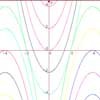
I plotted the first few equations with graphing software, and they all seemed to have the turning point at $(-2,0)$. I will now try and show this for all cases.
Taking $y=ax^2+2bx+c$, we can replace $a$, $b$ and $c$ by consective numbers from the geometic progression, say, $$\eqalign{a&=m\cr b&=2m\cr c&=2^2 m = 4m}$$ This gives us $$\eqalign{
y&=mx^2+2\times 2mx+4m\cr &= mx^2 + 4mx + 4m}$$
Now we differentiate to get $$\eqalign{\frac{dy}{dx}&= 2mx+4a \cr &= 2m(x+2)}$$
The turning point is given by $\frac{dy}{dx}= 0$, so $2m(x+2) = 0$ imples $x=-2$.
Substituting $x=-2$ into our equation for $y$ gives: $y=4m-8m+4m = 0$.
Therefore, all these curves have turning point at $(-2,0)$.
We can now generalise these ideas for any common ratio $n$.
As before we have: $$\eqalign{y&=ax^2 + 2bx + c\cr &= mx^2 + 2mnx + mn^2\cr &= m(x^2+2nx+n^2)}$$
Differentiating gives: $$dy/dx = 2mx + 2mn = 2m(x+n)$$
The x-coordinate of the turning point will thus be $-n$, and the y-coordinate is $(-n)^2 + 2n(-n) + n^2 = n^2 - 2n^2 + n^2 = 0$.
Therefore, for a quadratic in the form $y=ax^2+2bx+c$ where the coefficients are consequtive numbers in a geometric progression, the turning point of the curve will be $(-n,0)$. This will work regardless of whether n is natural or real.


Geometric Parabola
Age 14 to 16
Challenge Level 
Patrick from Woodbridge school sent us this solution:
I plotted the first few equations with graphing software, and they all seemed to have the turning point at $(-2,0)$. I will now try and show this for all cases.
Taking $y=ax^2+2bx+c$, we can replace $a$, $b$ and $c$ by consective numbers from the geometic progression, say, $$\eqalign{a&=m\cr b&=2m\cr c&=2^2 m = 4m}$$ This gives us $$\eqalign{
y&=mx^2+2\times 2mx+4m\cr &= mx^2 + 4mx + 4m}$$
Now we differentiate to get $$\eqalign{\frac{dy}{dx}&= 2mx+4a \cr &= 2m(x+2)}$$
The turning point is given by $\frac{dy}{dx}= 0$, so $2m(x+2) = 0$ imples $x=-2$.
Substituting $x=-2$ into our equation for $y$ gives: $y=4m-8m+4m = 0$.
Therefore, all these curves have turning point at $(-2,0)$.
We can now generalise these ideas for any common ratio $n$.
As before we have: $$\eqalign{y&=ax^2 + 2bx + c\cr &= mx^2 + 2mnx + mn^2\cr &= m(x^2+2nx+n^2)}$$
Differentiating gives: $$dy/dx = 2mx + 2mn = 2m(x+n)$$
The x-coordinate of the turning point will thus be $-n$, and the y-coordinate is $(-n)^2 + 2n(-n) + n^2 = n^2 - 2n^2 + n^2 = 0$.
Therefore, for a quadratic in the form $y=ax^2+2bx+c$ where the coefficients are consequtive numbers in a geometric progression, the turning point of the curve will be $(-n,0)$. This will work regardless of whether n is natural or real.
You may also like
Converse
Clearly if a, b and c are the lengths of the sides of an equilateral triangle then a^2 + b^2 + c^2 = ab + bc + ca. Is the converse true?
Consecutive Squares
The squares of any 8 consecutive numbers can be arranged into two sets of four numbers with the same sum. True of false?
Parabolic Patterns
The illustration shows the graphs of fifteen functions. Two of them have equations y=x^2 and y=-(x-4)^2. Find the equations of all the other graphs.