Skip over navigation


This problem follows on from Twisting and Turning and More Twisting and Turning
In More Twisting and Turning, you were invited to find a strategy to reduce any fraction $\frac ab$ to zero using only the operations Twist ($x \mapsto x+1$) and Turn ($x \mapsto -\frac1x$). In this problem, we will call these operations $T$ for twist, and $R$ for rotate (since 'turn' rather unhelpfully begins with a T too!).
To end up at $\frac{4}{5}$, you can carry out the following sequence of operations: $T,T,T,T,T,R,T$ which could be written more concisely as $T^5RT = \frac45$.
Can you find a sequence of operations that leads to $\frac{9}{10}$?
What about $\frac{23}{24}$?
Can you find a sequence of operations that gets from $0$ to the fraction $\frac{n}{n+1}$?
Can you prove that it is possible to start at zero and reach any fraction using only the operations $T$ and $R$?
All Tangled Up
Age 14 to 18
Challenge Level 

This problem follows on from Twisting and Turning and More Twisting and Turning
In More Twisting and Turning, you were invited to find a strategy to reduce any fraction $\frac ab$ to zero using only the operations Twist ($x \mapsto x+1$) and Turn ($x \mapsto -\frac1x$). In this problem, we will call these operations $T$ for twist, and $R$ for rotate (since 'turn' rather unhelpfully begins with a T too!).
To end up at $\frac{4}{5}$, you can carry out the following sequence of operations: $T,T,T,T,T,R,T$ which could be written more concisely as $T^5RT = \frac45$.
Can you find a sequence of operations that leads to $\frac{9}{10}$?
What about $\frac{23}{24}$?
Can you find a sequence of operations that gets from $0$ to the fraction $\frac{n}{n+1}$?
Now try the following sequences:
- $T^2RT$
- $T^2RT^2RT$
- $T^2RT^2RT^2RT$
What do you notice?
Can you find a way to reach $\frac{1}{10}$?
Can you prove that the pattern will continue?
Can you find other patterns that lead to interesting fractions?Can you find a way to reach $\frac{1}{10}$?
Can you prove that the pattern will continue?
Can you prove that it is possible to start at zero and reach any fraction using only the operations $T$ and $R$?
You may also like

There's a Limit
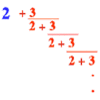
Explore the continued fraction: 2+3/(2+3/(2+3/2+...)) What do you notice when successive terms are taken? What happens to the terms if the fraction goes on indefinitely?
Not Continued Fractions
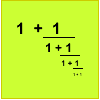
Which rational numbers cannot be written in the form x + 1/(y + 1/z) where x, y and z are integers?