Skip over navigation


David from St Peter's College in Adelaide, Dakshesk from Richard Huish College and Ruairi from The Skinners' School in the UK all sent in full solutions.
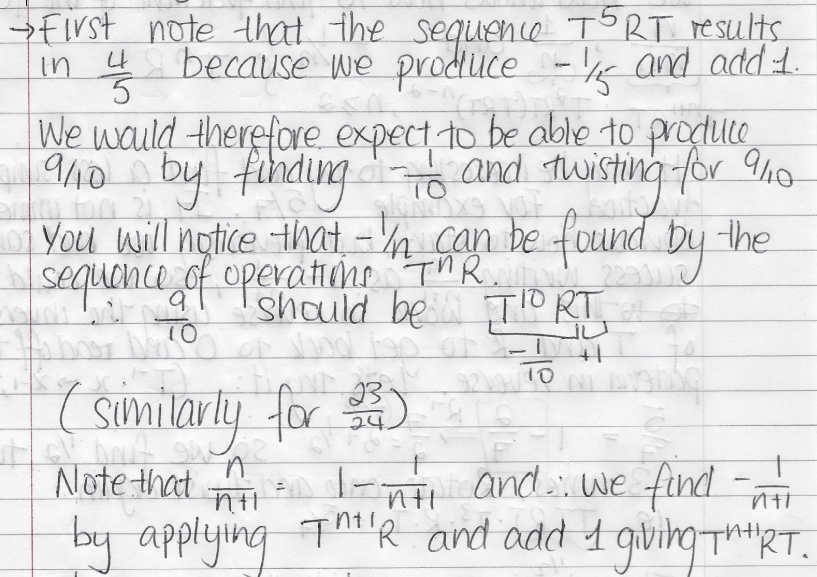
Ruairi explained how to form sequences leading to fractions of the form $\frac{n}{n+1}$:
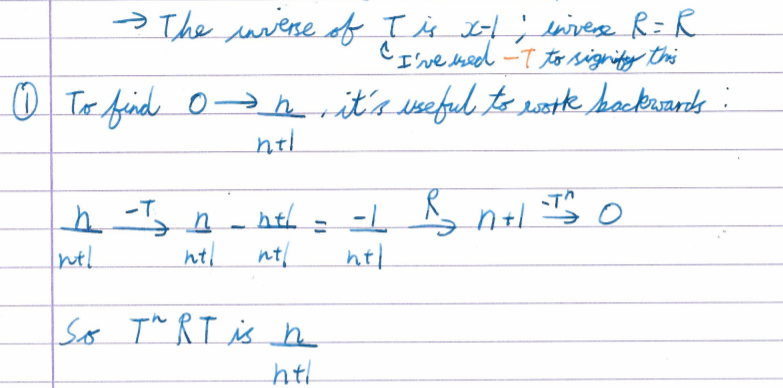
Dakshesh's method involved working backwards:
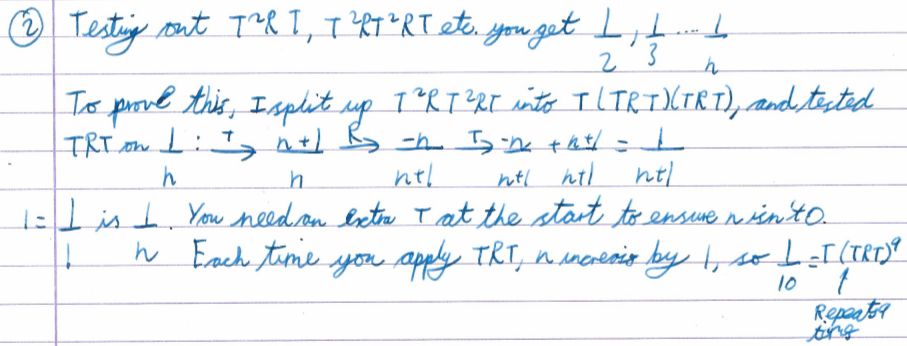
This is Dakshesk's explanation of how to make fractions of the form $\frac1n$:
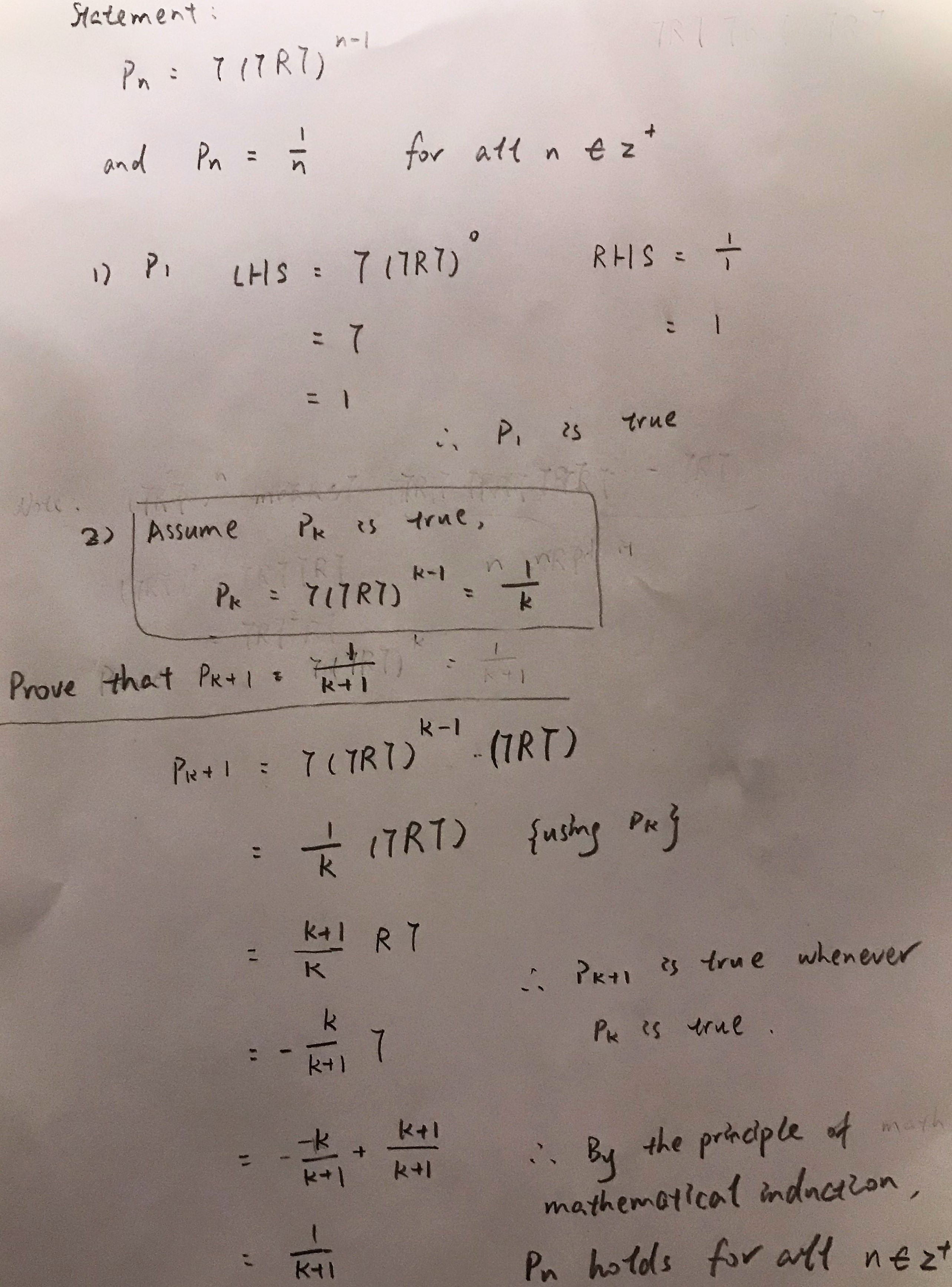
David used this idea to form a proof by induction:
To prove it is possible to make any fraction, David and Ruairi used the idea of working backwards. Dakshesh contsructed a proof by looking for patterns. All are shown below.
David described a strategy for working backwards:
We can work it backwards, which means finding a method of reducing any fraction to $0$ by using $T^{-1}$, which is $x↦x−1$, and $R$ (since the inverse of $R$ is also itself)
With any positive fraction, we use operation $T^{-1}$ to reduce that fraction to a negative fraction, and then use $R$ to turn it back to a positive fraction. Once it becomes a positive fraction, then continue use $T^{-1}$ to reduce it to a negative fraction. And once it becomes a negative fraction, use $R$ to turn it back to positive fraction. Notice that, by doing these operations, the denominator will get smaller and smaller until it gets to $1.$
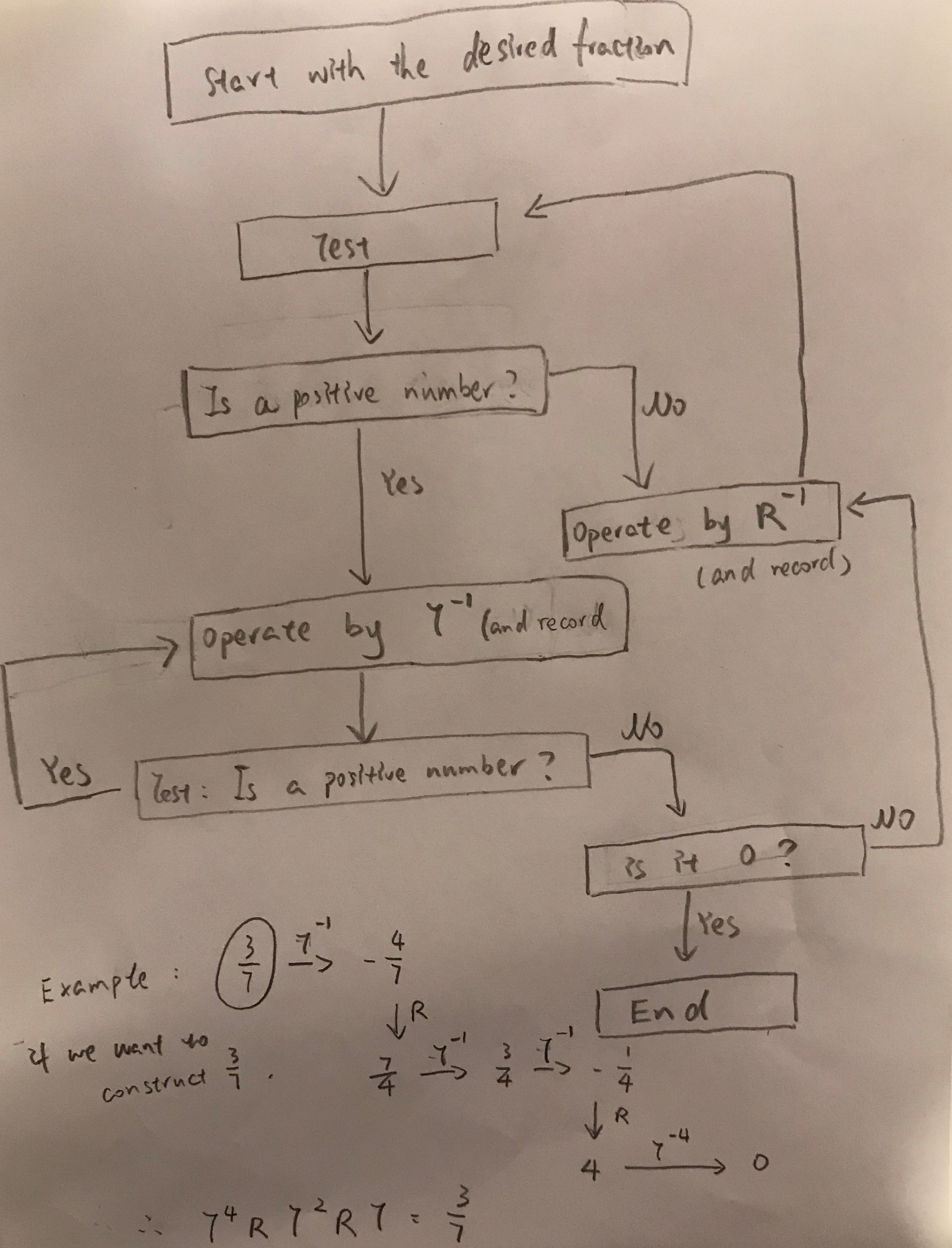
For example, if we start with $\frac{10}7$ ,we operate it by $T^{-2}$ to get $-\frac47$ and use $R$ to get $\frac74$, and then operate it by $T^{-2}$ to get $-\frac14$, then use $R$ to get $4$, and operate it by $T^{-4}$ to get $0.$
(So to get to $\frac{10}7$, repeat the process backwards: $T^4RT^2RT^2$)
Click here to see David's diagram illustrating this method.
Ruairi went into more detail to show that this process leads to zero:
To prove that it is possible to reach any fraction, we only need to prove that a method exists to reach its fraction part [e.g. the fraction part of $\frac{10}7 = 1\frac37$ is $\frac37$], as we can add necessary [whole numbers] by twisting the required number of times.
Take a fraction $\frac ab, a \lt b$, $a$ and $b$ are both natural numbers.
$\frac ab = 1 - \frac{b-a}b$ (so applying $T^{-1}$ to $\frac ab$ gives $-\frac{b-a}b$]
Applying $R^{-1}$ (to $-\frac{b-a}b$) gives $\frac{b}{b-a}$
As $b$ and $a$ are positive and $b>a$, $b-a$ is lower than $b,$ so this can be broken up into a [whole number] and fraction part with numerator less than $b$.
By induction if we repeat this, each time the denominator and the numerator decrease until either the denominator becomes $1$ in which case we have an integer which is easily found, or a fraction $\frac1n$, which we have also found a method to find, so it follows that every rational number can have a sequence of the functions $T$ and $R$ produced by applying this method and reading it off in reverse.
A note on efficiency: It is entirely conceivable that for some fractions there are sequences that reach the result in fewer steps, this is just one possible algorithm that could be used.
Dakshesh began by finding some fractions, and then worked from the patterns that emerged. Click here to see Dakshesh's proof.
All Tangled Up
Age 14 to 18
Challenge Level 

David from St Peter's College in Adelaide, Dakshesk from Richard Huish College and Ruairi from The Skinners' School in the UK all sent in full solutions.
Ruairi explained how to form sequences leading to fractions of the form $\frac{n}{n+1}$:
Dakshesh's method involved working backwards:
This is Dakshesk's explanation of how to make fractions of the form $\frac1n$:
David used this idea to form a proof by induction:
To prove it is possible to make any fraction, David and Ruairi used the idea of working backwards. Dakshesh contsructed a proof by looking for patterns. All are shown below.
David described a strategy for working backwards:
We can work it backwards, which means finding a method of reducing any fraction to $0$ by using $T^{-1}$, which is $x↦x−1$, and $R$ (since the inverse of $R$ is also itself)
With any positive fraction, we use operation $T^{-1}$ to reduce that fraction to a negative fraction, and then use $R$ to turn it back to a positive fraction. Once it becomes a positive fraction, then continue use $T^{-1}$ to reduce it to a negative fraction. And once it becomes a negative fraction, use $R$ to turn it back to positive fraction. Notice that, by doing these operations, the denominator will get smaller and smaller until it gets to $1.$
For example, if we start with $\frac{10}7$ ,we operate it by $T^{-2}$ to get $-\frac47$ and use $R$ to get $\frac74$, and then operate it by $T^{-2}$ to get $-\frac14$, then use $R$ to get $4$, and operate it by $T^{-4}$ to get $0.$
(So to get to $\frac{10}7$, repeat the process backwards: $T^4RT^2RT^2$)
Click here to see David's diagram illustrating this method.
Ruairi went into more detail to show that this process leads to zero:
To prove that it is possible to reach any fraction, we only need to prove that a method exists to reach its fraction part [e.g. the fraction part of $\frac{10}7 = 1\frac37$ is $\frac37$], as we can add necessary [whole numbers] by twisting the required number of times.
Take a fraction $\frac ab, a \lt b$, $a$ and $b$ are both natural numbers.
$\frac ab = 1 - \frac{b-a}b$ (so applying $T^{-1}$ to $\frac ab$ gives $-\frac{b-a}b$]
Applying $R^{-1}$ (to $-\frac{b-a}b$) gives $\frac{b}{b-a}$
As $b$ and $a$ are positive and $b>a$, $b-a$ is lower than $b,$ so this can be broken up into a [whole number] and fraction part with numerator less than $b$.
By induction if we repeat this, each time the denominator and the numerator decrease until either the denominator becomes $1$ in which case we have an integer which is easily found, or a fraction $\frac1n$, which we have also found a method to find, so it follows that every rational number can have a sequence of the functions $T$ and $R$ produced by applying this method and reading it off in reverse.
A note on efficiency: It is entirely conceivable that for some fractions there are sequences that reach the result in fewer steps, this is just one possible algorithm that could be used.
Dakshesh began by finding some fractions, and then worked from the patterns that emerged. Click here to see Dakshesh's proof.
You may also like

There's a Limit
Explore the continued fraction: 2+3/(2+3/(2+3/2+...)) What do you notice when successive terms are taken? What happens to the terms if the fraction goes on indefinitely?
Not Continued Fractions
Which rational numbers cannot be written in the form x + 1/(y + 1/z) where x, y and z are integers?