
Skip over navigation
Cambridge University Faculty of Mathematics NRich logo
menu search
  • Teachers expand_more
    • Early years
    • Primary
    • Secondary
    • Post-16
    • Events
    • Professional development
  • Students expand_more
    • Primary
    • Secondary
    • Post-16
  • Parents expand_more
    • Early Years
    • Primary
    • Secondary
    • Post-16
  • Problem-Solving Schools
  • About NRICH expand_more
    • About us
    • Impact stories
    • Support us
    • Our funders
    • Contact us
  • search

Or search by topic

Number and algebra

  • The Number System and Place Value
  • Calculations and Numerical Methods
  • Fractions, Decimals, Percentages, Ratio and Proportion
  • Properties of Numbers
  • Patterns, Sequences and Structure
  • Algebraic expressions, equations and formulae
  • Coordinates, Functions and Graphs

Geometry and measure

  • Angles, Polygons, and Geometrical Proof
  • 3D Geometry, Shape and Space
  • Measuring and calculating with units
  • Transformations and constructions
  • Pythagoras and Trigonometry
  • Vectors and Matrices

Probability and statistics

  • Handling, Processing and Representing Data
  • Probability

Working mathematically

  • Thinking mathematically
  • Developing positive attitudes
  • Cross-curricular contexts

Advanced mathematics

  • Decision Mathematics and Combinatorics
  • Advanced Probability and Statistics
  • Mechanics
  • Calculus

For younger learners

  • Early Years Foundation Stage

Creating and Manipulating Linear and Quadratic Expressions - Stage 4
2-digit Square

Age 14 to 16
Challenge Level Yellow starYellow starYellow star

A 2-Digit number is squared. When this 2-digit number is reversed and squared, the difference between the squares is also a square. What is the 2-digit number?
Plus Minus

Age 14 to 16
Challenge Level Yellow starYellow star

Can you explain the surprising results Jo found when she calculated the difference between square numbers?

What's Possible?

Age 14 to 16
Challenge Level Yellow starYellow star

Many numbers can be expressed as the difference of two perfect squares. What do you notice about the numbers you CANNOT make?

Why 24?

Age 14 to 16
Challenge Level Yellow starYellow star

Take any prime number greater than 3 , square it and subtract one. Working on the building blocks will help you to explain what is special about your results.

Always Perfect

Age 14 to 18
Challenge Level Yellow starYellow star

Show that if you add 1 to the product of four consecutive numbers the answer is ALWAYS a perfect square.

Pair Products

Age 14 to 16
Challenge Level Yellow star

Choose four consecutive whole numbers. Multiply the first and last numbers together. Multiply the middle pair together. What do you notice?
Perfectly Square

Age 14 to 16
Challenge Level Yellow starYellow star

The sums of the squares of three related numbers is also a perfect square - can you explain why?

Multiplication Square

Age 14 to 16
Challenge Level Yellow starYellow star

Pick a square within a multiplication square and add the numbers on each diagonal. What do you notice?
Finding Factors

Age 14 to 16
Challenge Level Yellow star

Can you find the hidden factors which multiply together to produce each quadratic expression?
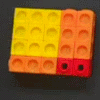
Factorising with Multilink

Age 14 to 16
Challenge Level Yellow star

Can you find out what is special about the dimensions of rectangles you can make with squares, sticks and units?

Pythagoras Perimeters

Age 14 to 16
Challenge Level Yellow starYellow star

If you know the perimeter of a right angled triangle, what can you say about the area?
Difference of Two Squares

Age 14 to 16
Challenge Level Yellow starYellow star

What is special about the difference between squares of numbers adjacent to multiples of three?
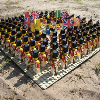
Hollow Squares

Age 14 to 16
Challenge Level Yellow star

Which armies can be arranged in hollow square fighting formations?

Harmonic Triangle

Age 14 to 16
Challenge Level Yellow starYellow starYellow star

Can you see how to build a harmonic triangle? Can you work out the next two rows?

Creating and Manipulating Linear and Quadratic Expressions - Short Problems

Age 11 to 16

A collection of short problems on creating algebraic expressions.

Square Number Surprises

Age 14 to 16
Challenge Level Yellow starYellow star

There are unexpected discoveries to be made about square numbers...
Puzzling Place Value

Age 14 to 16
Challenge Level Yellow starYellow star

Can you explain what is going on in these puzzling number tricks?

Brian's Number

Age 14 to 16
ShortChallenge Level Yellow starYellow star

Brian chooses an integer and operates on it. Work out the largest integer that he could have chosen.

Choir Boys

Age 14 to 16
ShortChallenge Level Yellow starYellow starYellow star

Can you work out how many members this choir has from these percentages?

Cuboid Perimeters

Age 14 to 16
ShortChallenge Level Yellow starYellow star

Can you find the volume of a cuboid, given its perimeters?

Third Side

Age 14 to 16
ShortChallenge Level Yellow starYellow starYellow star

What are the possible lengths for the third side of this right-angled triangle?

Stolen Pension

Age 14 to 16
ShortChallenge Level Yellow starYellow starYellow star

How much money did the pensioner have before being robbed?

Clever Calculation

Age 14 to 16
ShortChallenge Level Yellow starYellow star

Find the shortcut to do this calculation quickly!

Order the Products

Age 14 to 16
ShortChallenge Level Yellow starYellow star

Can you put these products in order of size?

Length, Width and Area

Age 14 to 16
ShortChallenge Level Yellow star

The area of a rectangle is 225 square units. Find its width.

Find the Factor

Age 14 to 16
ShortChallenge Level Yellow starYellow starYellow star

Find a factor of $2^{48}-1$.

  • Tech help
  • Accessibility Statement
  • Sign up to our newsletter
  • Twitter X logo

The NRICH Project aims to enrich the mathematical experiences of all learners. To support this aim, members of the NRICH team work in a wide range of capacities, including providing professional development for teachers wishing to embed rich mathematical tasks into everyday classroom practice.

NRICH is part of the family of activities in the Millennium Mathematics Project.

University of Cambridge logo NRICH logo