Skip over navigation
Cambridge University Faculty of Mathematics NRich logo
menu search
  • Teachers expand_more
    • Early years
    • Primary
    • Secondary
    • Post-16
    • Events
    • Professional development
  • Students expand_more
    • Primary
    • Secondary
    • Post-16
  • Parents expand_more
    • Early Years
    • Primary
    • Secondary
    • Post-16
  • Problem-Solving Schools
  • About NRICH expand_more
    • About us
    • Impact stories
    • Support us
    • Our funders
    • Contact us
  • search

Or search by topic

Number and algebra

  • The Number System and Place Value
  • Calculations and Numerical Methods
  • Fractions, Decimals, Percentages, Ratio and Proportion
  • Properties of Numbers
  • Patterns, Sequences and Structure
  • Algebraic expressions, equations and formulae
  • Coordinates, Functions and Graphs

Geometry and measure

  • Angles, Polygons, and Geometrical Proof
  • 3D Geometry, Shape and Space
  • Measuring and calculating with units
  • Transformations and constructions
  • Pythagoras and Trigonometry
  • Vectors and Matrices

Probability and statistics

  • Handling, Processing and Representing Data
  • Probability

Working mathematically

  • Thinking mathematically
  • Developing positive attitudes
  • Cross-curricular contexts

Advanced mathematics

  • Decision Mathematics and Combinatorics
  • Advanced Probability and Statistics
  • Mechanics
  • Calculus

For younger learners

  • Early Years Foundation Stage
NRICH topics: Patterns, sequences and structure Fibonacci sequence

Resources tagged with: Fibonacci sequence

Content type:
Age range:
Challenge level:

There are 30 NRICH Mathematical resources connected to Fibonacci sequence, you may find related items under Patterns, sequences and structure.

Broad Topics > Patterns, sequences and structure > Fibonacci sequence

Problem Primary curriculum Secondary curriculum

Fibonacci Surprises

Play around with the Fibonacci sequence and discover some surprising results!

Age 11 to 14
Challenge Level Yellow starYellow star
Problem Primary curriculum Secondary curriculum

1 Step 2 Step

Liam's house has a staircase with 12 steps. He can go down the steps one at a time or two at time. In how many different ways can Liam go down the 12 steps?
Age 11 to 14
Challenge Level Yellow starYellow star
Problem Primary curriculum Secondary curriculum

Fibs

The well known Fibonacci sequence is 1 ,1, 2, 3, 5, 8, 13, 21.... How many Fibonacci sequences can you find containing the number 196 as one of the terms?

Age 11 to 14
Challenge Level Yellow starYellow starYellow star
Problem Primary curriculum Secondary curriculum

Farey Fibonacci

Investigate Farey sequences of ratios of Fibonacci numbers.
Age 16 to 18
ShortChallenge Level Yellow star
Problem Primary curriculum Secondary curriculum

Building Gnomons

Build gnomons that are related to the Fibonacci sequence and try to explain why this is possible.

Age 14 to 16
Challenge Level Yellow star
Problem Primary curriculum Secondary curriculum

Simple Train Journeys

How many different journeys could you make if you were going to visit four stations in this network? How about if there were five stations? Can you predict the number of journeys for seven stations?

Age 5 to 11
Challenge Level Yellow star
Problem Primary curriculum Secondary curriculum

First Forward Into Logo 11: Sequences

This part introduces the use of Logo for number work. Learn how to use Logo to generate sequences of numbers.
Age 11 to 18
Challenge Level Yellow star
Article Primary curriculum Secondary curriculum

Whirling Fibonacci Squares

Draw whirling squares and see how Fibonacci sequences and golden rectangles are connected.
Age 11 to 16
Problem Primary curriculum Secondary curriculum

Colour Building

Using only the red and white rods, how many different ways are there to make up the other rods?
Age 11 to 14
Challenge Level Yellow star
Problem Primary curriculum Secondary curriculum

Plus or Minus

Make and prove a conjecture about the value of the product of the Fibonacci numbers $F_{n+1}F_{n-1}$.
Age 16 to 18
Challenge Level Yellow starYellow starYellow star
Problem Primary curriculum Secondary curriculum

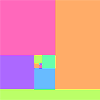
Pythagorean Fibs

What have Fibonacci numbers got to do with Pythagorean triples?
Age 16 to 18
Challenge Level Yellow starYellow star
Problem Primary curriculum Secondary curriculum

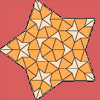
Fibonacci Fashion

What have Fibonacci numbers to do with solutions of the quadratic equation x^2 - x - 1 = 0 ?
Age 16 to 18
Challenge Level Yellow starYellow star
Article Primary curriculum Secondary curriculum

Golden Mathematics

A voyage of discovery through a sequence of challenges exploring properties of the Golden Ratio and Fibonacci numbers.

Age 16 to 18
Article Primary curriculum Secondary curriculum

The Golden Ratio, Fibonacci Numbers and Continued Fractions.

An iterative method for finding the value of the Golden Ratio with explanations of how this involves the ratios of Fibonacci numbers and continued fractions.
Age 14 to 16
Problem Primary curriculum Secondary curriculum

Golden Fractions

Find the link between a sequence of continued fractions and the ratio of succesive Fibonacci numbers.

Age 16 to 18
Challenge Level Yellow starYellow starYellow star
Problem Primary curriculum Secondary curriculum

Sheep Talk

In sheep talk the only letters used are B and A. A sequence of words is formed by following certain rules. What do you notice when you count the letters in each word?

Age 7 to 11
Challenge Level Yellow starYellow starYellow star
Game Primary curriculum Secondary curriculum

Last Biscuit

Can you find a strategy that ensures you get to take the last biscuit in this game?

Age 11 to 18
Challenge Level Yellow starYellow star
Article Primary curriculum Secondary curriculum

Leonardo of Pisa and the Golden Rectangle

Leonardo who?! Well, Leonardo is better known as Fibonacci and this article will tell you some of fascinating things about his famous sequence.
Age 7 to 16
Article Primary curriculum Secondary curriculum

Fibonacci's Three Wishes 2

Second of two articles about Fibonacci, written for students.
Age 7 to 14
Problem Primary curriculum Secondary curriculum

Golden Fibs

When is a Fibonacci sequence also a geometric sequence? When the ratio of successive terms is the golden ratio!
Age 16 to 18
Challenge Level Yellow starYellow star
Problem Primary curriculum Secondary curriculum

Fibonacci Factors

For which values of n is the Fibonacci number fn even? Which Fibonnaci numbers are divisible by 3?
Age 16 to 18
Challenge Level Yellow star
Problem Primary curriculum Secondary curriculum

Ordered Sums

Let a(n) be the number of ways of expressing the integer n as an ordered sum of 1's and 2's. Let b(n) be the number of ways of expressing n as an ordered sum of integers greater than 1. (i) Calculate a(n) and b(n) for n<8. What do you notice about these sequences? (ii) Find a relation between a(p) and b(q). (iii) Prove your conjectures.
Age 14 to 16
Challenge Level Yellow starYellow star
Problem Primary curriculum Secondary curriculum

Stringing it Out

Explore the transformations and comment on what you find.
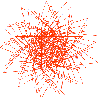
Age 14 to 16
Challenge Level Yellow star
Problem Primary curriculum Secondary curriculum

Spirals Instead of Sunflowers

Using logo to investigate spirals

Age 11 to 16
Challenge Level Yellow star
Problem Primary curriculum Secondary curriculum

LOGO Challenge - Circles as Bugs

Here are some circle bugs to try to replicate with some elegant programming, plus some sequences generated elegantly in LOGO.
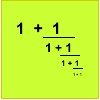
Age 11 to 16
Challenge Level Yellow starYellow star
Article Primary curriculum Secondary curriculum

Continued Fractions I

An article introducing continued fractions with some simple puzzles for the reader.
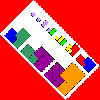
Age 14 to 18
Problem Primary curriculum Secondary curriculum

Gnomon Dimensions

These gnomons appear to have more than a passing connection with the Fibonacci sequence. This problem ask you to investigate some of these connections.
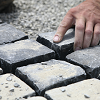
Age 14 to 16
Challenge Level Yellow starYellow star
Problem Primary curriculum Secondary curriculum

Paving Paths

How many different ways can I lay 10 paving slabs, each 2 foot by 1 foot, to make a path 2 foot wide and 10 foot long from my back door into my garden, without cutting any of the paving slabs?

Age 11 to 14
Challenge Level Yellow starYellow star
Problem Primary curriculum Secondary curriculum

Golden Powers

You add 1 to the golden ratio to get its square. How do you find higher powers?
Age 16 to 18
Challenge Level Yellow starYellow star
Problem Primary curriculum Secondary curriculum

Room Doubling

Investigate the different ways you could split up these rooms so that you have double the number.

Age 7 to 11
Challenge Level Yellow starYellow star

  • Tech help
  • Accessibility Statement
  • Sign up to our newsletter
  • Twitter X logo

The NRICH Project aims to enrich the mathematical experiences of all learners. To support this aim, members of the NRICH team work in a wide range of capacities, including providing professional development for teachers wishing to embed rich mathematical tasks into everyday classroom practice.

NRICH is part of the family of activities in the Millennium Mathematics Project.

University of Cambridge logo NRICH logo